

How to Promote a Book on Facebook
Make your author presence useful, show the actual book and participate in groups only where promotion is welcome. Use ready-to-adapt post structures rather than mass posting the same advertisement.
Plan reader-fit posts, demonstrations and accurate availability updates, then review destination activity separately from reactions and paid reach.
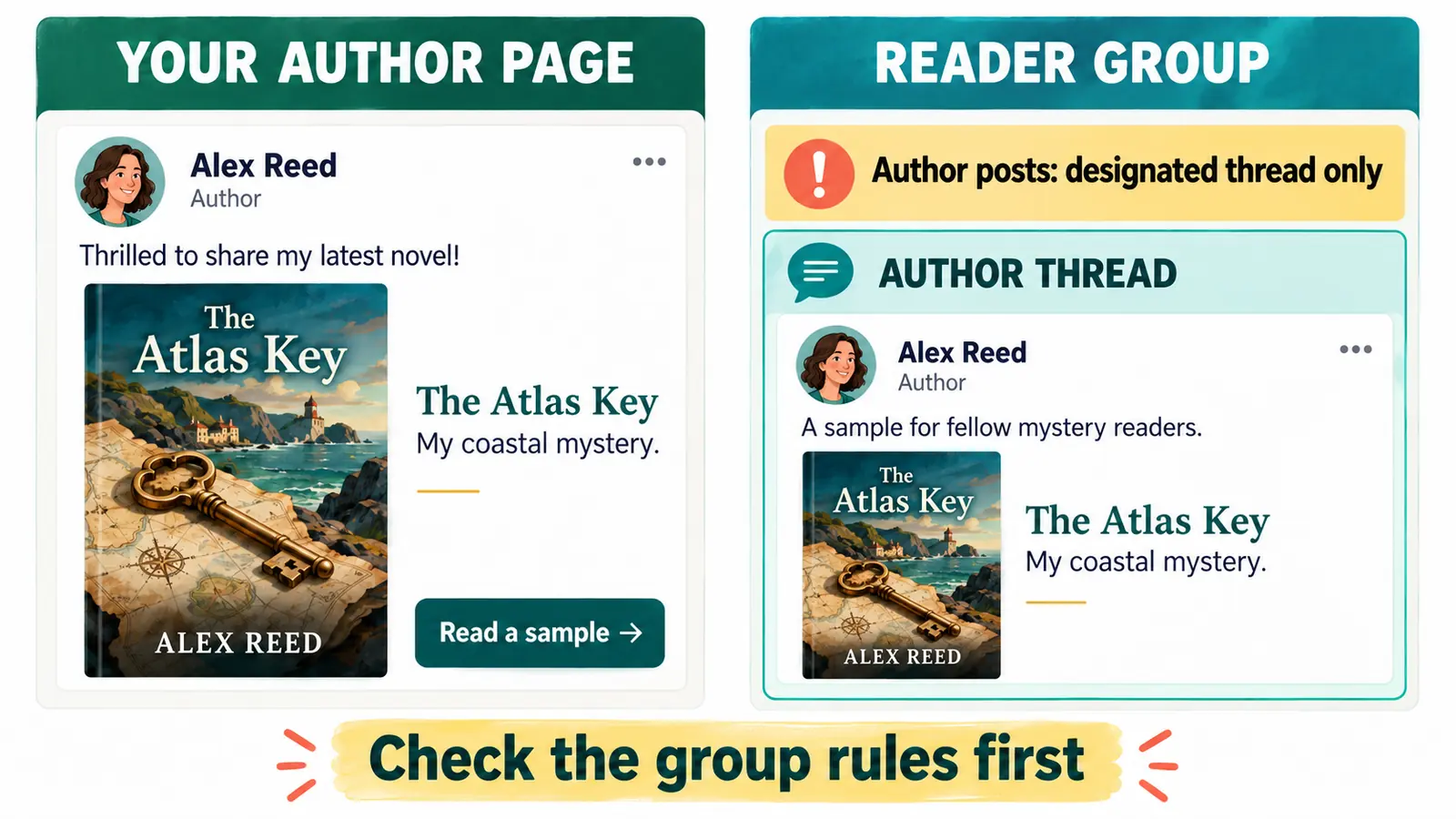
How to promote a book on Facebook without turning every interaction into an ad
Use your author presence to explain the book, show the reading experience and answer questions. Participate in other people's communities only where your contribution and any promotion are allowed. Keep your own Page, a group you manage and another group's promotional thread as separate channels.
The examples are fictional templates to adapt, not campaign case studies. Platform sources checked on 17 October 2026. Controls, account access and reporting vary; verify what your own account offers instead of relying on an old menu walkthrough.
The Page-access and Reels help references were checked through indexed official text after their public URLs redirected to login. This is not a test of your current permissions, menus or ad eligibility.
Make a useful introduction easy to find
State your author name, genre or topic, available book and one appropriate destination. Use a recognizable, authorized photograph or brand image. The visitor should understand whether the link opens a sample, retailer page or signup form.
- Check the book title and edition against the destination.
- Update obsolete launch dates and expired offers.
- Test the destination on mobile.
- Provide a real route for access or format questions.
- If an introduction can be pinned in your interface, keep it current.
Manage access without sharing passwords
If an assistant helps, use the appropriate Page permissions. Meta's Page-access guidance distinguishes Facebook access and task access, with different abilities. Give only what the work requires; full control can include the ability to remove other managers or delete the Page.
Agree on the task before granting access: draft content, publish, reply, view insights or manage paid distribution. Test the assigned access and remove it when the work ends. Do not hand over a personal login merely because an assistant cannot see the control they expected.
1. Choose a format for a specific reader question
| Format | Concrete book content | Useful next action |
|---|---|---|
| Photo and caption | Actual cover and a precise reader-fit description | Inspect the sample or description |
| Page demonstration video | One real exercise, recipe step or puzzle method | Preview the interior |
| Short reading or Reel | An authorized passage with understandable captions | Continue reading the opening |
| Substantive question | A relevant reading preference or practical obstacle | Discuss the topic voluntarily |
| Availability update | Correct edition, marketplace, offer and dates | Open the retailer page |
Do not claim one format always wins. A detailed nonfiction answer and a suspenseful opening solve different reader tasks. Pick two formats you can create well and compare them against their intended outcomes.
Keep the video legible
Show the actual book or a clear demonstration early. Use readable captions, clean audio and text that does not disappear under interface controls. For vertical creative, Meta's Reels advertising guidance discusses 9:16 framing and safe zones. That is a production reference, not a sales forecast for an organic book post.
2. Adapt these three ready-to-use structures
A fiction sample post
"The librarian knows who borrowed every atlas in town. She does not know why one came back with a key to a building that no longer exists. My closed-door coastal mystery follows a small-town puzzle with an increasingly strange history. Read the opening chapter at [sample link] to see whether the voice is for you."
Pair it with your actual cover or original setting photograph. This invented premise is not an excerpt to reuse as if it describes your book. Keep the real genre and tone specific, and do not hide important reader-fit information behind empty praise.
Before posting, check the hook against your own book using the description claim audit. Then open the published link as a reader and verify that the opening chapter is available for the edition you described.
A useful nonfiction demonstration
"One-pan dinner, three cooking times: start the slower ingredients first, then add the quicker ones. Here is the sequence from one recipe in my beginner cookbook, shown with the actual pan and ingredients. The complete sample includes quantities and timing at [sample link]."
Show a complete, accurate example. Do not use a purchased stock meal as proof you made the recipe or suggest an unsupported health benefit. A useful demonstration should still make sense to someone who does not click.
An accurate availability post
"[Title] is now available in [format]. It is for [reader], with [specific feature]. The [marketplace] edition is [verified price] through [end date and time zone]. Preview the pages and check the current price here: [edition link]."
Remove the discount sentence when there is no verified promotion. Never invent urgency or say a book is free when it is only included in a subscription. See the Kindle offer guide when coordinating an ebook discount.
3. Treat groups as communities with their own rules
Choose a small number of groups where the book's readers actually discuss relevant topics. Read the rules, recent admin posts and promotional-thread instructions before sharing a link. Some groups permit author participation but prohibit self-promotion; those are not the same permission.
Ask a precise permission question
"I wrote a beginner guide to [topic]. Is an author post showing one sample exercise allowed here, and should it go in a particular thread? I can share the useful example without a purchase link if that better fits your rules."
Do not send this request to dozens of moderators automatically. If promotion is not welcome, accept the answer. A moderator's approval also does not override platform rules or authorize unsolicited messages to members.
Keep a minimal permission note: group, applicable rule, approved thread, date and any stated frequency. Check it again before a later campaign. Approval for one sample post is not standing approval for a launch sequence or paid use of member comments.
- Use the designated thread and permitted frequency.
- Identify yourself as the author.
- Contribute information relevant to the conversation.
- Do not insert an unrelated purchase link into another author's discussion.
- Do not scrape the group, mass-tag members or send bulk sales messages.
- Do not create alternate accounts to repost a removed promotion.
A substantive question might ask what makes instructions difficult to follow in a beginner workbook. It should not be an artificial "comment YES" gate for a link that could simply be provided where allowed. Meta's spam guidance specifically addresses coordinated fake engagement and irrelevant captions.
Fictional permission example: a group permits one sample paragraph in its weekly author thread and prohibits external links. Share that self-contained paragraph in the thread, without a purchase or sample URL. Your own Page can carry the fuller sample invitation, but the Page's posting schedule does not expand the group's permission. Do not message everyone who reacts to move the promotion into their inbox.
4. Prepare a modest launch-week sequence
| When | Post | Prepare first |
|---|---|---|
| Before availability | Reader-fit message and sample | Working sample destination and truthful release status |
| Availability day | Actual edition and purchase information | Live retailer link, format, currency and territory |
| Later in the week | Page demonstration or authorized reading | Readable footage, captions and rights |
| End of the week | Answer a genuine recurring question | Accurate answer; no invented reader testimonial |
This is a workload example, not a required posting frequency. Separate group activity from this schedule. A group does not owe you a post on every launch milestone, even if your own Page carries one.
Leave time to reply to book-format and access questions. For a negative opinion, clarify factual errors calmly without arguing over taste. Remove personal information or abuse when appropriate, not every critical response. The general social guide explains how to reuse the strongest format without repeating identical advertisements.
5. Check originality, rights and commercial relationships
Produce your own useful material. Meta's original-content update distinguishes original work and meaningful contributions from low-value reuse of another creator's post. Adding a border or changing playback speed is not a sound basis for borrowing someone else's work.
Check the permission for every excerpt, image, recording and music track, particularly when turning an organic post into an ad. Availability in an editor is not proof that every commercial use or cross-platform reuse is licensed. When unsure, use your own narration without background music.
For a creator collaboration, record the specific asset, channels, organic or paid use, duration, editing permission and agreed disclosure. Treat a later boosted version as a new rights check, not an automatic extension of permission to publish the original post.
Worked rights check: a collaborator allows one organic Page post with their footage. That agreement does not itself authorize a boosted version, an edited testimonial or a cross-platform repost. Obtain the specific additional permission before using the asset that way; moderator approval of a group post cannot grant the creator's rights.
Disclose payment or a free-copy relationship in a creator endorsement where required; the FTC disclosure guide is a useful US-facing reference. A sponsored creator post must not be presented as an unpaid reader testimonial. Do not buy favorable ratings or offer prizes for retailer reviews.
Giveaways are not included as a default tactic here. Before organizing one, check the current platform promotion terms and applicable local requirements separately. This page does not provide a contest-rules template or a guarantee of legal compliance.
6. Treat paid distribution as a separate test
If you choose a paid campaign, write down the intended audience, destination, observable result, total spending cap and review date first. Check current ad policies and creative eligibility in your account. Organic reach does not prove that a post is eligible for paid distribution.
Do not buy extra reactions as a substitute for qualified visits. Nor should you select a sales objective and assume purchases can be observed on a retailer checkout you do not control. Match the campaign to the measurement you can actually access.
Write the success criterion before spending: for example, a correctly recorded visit to your sample page, not merely a reaction to the cover. Record the paid run's dates separately so a combined total is not reported as organic reach.
State a stop condition
Pause when the destination is broken, the offer is wrong, the creative is misleading or the test reaches its loss limit without useful evidence. Never keep spending solely because a post has many likes. Ads need a separate plan; these organic post examples are not a full Ads Manager tutorial.
7. Review reader actions, not just reactions
Use the Page or Meta Business Suite insights available with your access. The official access guide includes performance insights among Page management tasks. Record the actual metric names and definitions shown, especially when comparing a video with a photo post.
Track post, date, format, reader promise, destination, production time and spend. Use consistent campaign tags on links to your own configured website; the social measurement section provides a naming example. Platform clicks, website visits and retailer orders will not necessarily reconcile one-to-one.
Before recording "clicks", read the metric's definition in your account: does it count a destination visit, a link interaction or something broader? Keep that exact label and reporting period. Do not rename an engagement count as website traffic or assume it establishes a book purchase.
Record a permission failure separately from a traffic result. If a post was removed under group rules, stop that placement and revise the plan; do not record it as a completed campaign with zero buyer interest. Use the bounded test record to keep delivery evidence, available metrics and conclusions separate.
Interpret the weak step
If discussion is relevant but visits are low, the post may be doing a community job rather than a purchase job. If visits arrive but the sample is unused, test the destination and reader-fit message. If a discounted book attracts attention without enough royalties, evaluate its economics before repeating the spend.
Keep group-member information out of your reporting sheet. Record aggregate results and voluntary inquiries instead. Then repeat one useful format with a new example, and connect it to your author platform and marketing checklist.
Explore the book marketing guides to connect this task with launch planning, audience building and promotion.
Frequently asked questions
Should I use my own Page or other Facebook groups?
They serve different roles. Use your own author presence for current book information and helpful posts. In another group, follow its rules and promotional-thread instructions; membership does not grant permission to advertise.
How do I ask a group admin about book promotion?
Explain the relevant topic, that you are the author, the proposed useful example and whether it includes a link. Ask where it belongs, accept a refusal and do not automate the same request to large numbers of moderators.
What makes a useful Facebook book post?
A clear reader-fit premise, real page demonstration, authorized reading or accurate availability update gives someone a reason to act. Use one next step and make the linked edition or sample match the post.
Should I boost a post because it has many likes?
Likes alone do not justify paid distribution. First confirm the audience, destination, observable goal, spending cap and policy eligibility. Keep paid results separate from organic results and stop when the test reaches its limit.
Can I reuse a reader's comment as an advertisement?
Do not assume a public comment authorizes advertising reuse of the text, name or photograph. Obtain appropriate permission for the exact use, preserve the meaning and do not make an ordinary question look like a testimonial.
Which Facebook metrics should I compare?
Use the metric definitions available in your account and compare similar formats and windows. Record relevant interactions and destination activity separately. Reactions, website visits and retailer orders are not the same outcome.