
Understanding Amazon Ads for Books
Amazon Ads for books are sponsored placements that help authors show their titles to readers inside the Amazon marketplace. Instead of waiting only for organic discoverability, authors can use ads to place books directly in front of people who are already searching, browsing, and comparing books.
These ads usually appear in high-visibility areas such as Amazon search results, product pages, and other placements where readers are making buying decisions. Because the ads are shown inside the same ecosystem where books are discovered and purchased, they can become an important part of a book marketing strategy.
For self-published authors, Amazon Ads are often used to support a launch, increase traffic to a book listing, test keyword demand, and reach readers beyond organic search exposure. In some cases, ads also help authors learn which titles, themes, or niches attract stronger interest from readers.
At the same time, advertising does not guarantee profitable sales. More impressions and more clicks only create opportunity. The final result still depends on factors such as cover quality, title clarity, pricing, reviews, conversion strength, and how well the book matches reader intent.
Understanding Amazon Ads for books means understanding more than just campaign setup. Authors also need to think about targeting, ad costs, conversion, optimization, and long-term profitability. When used with realistic expectations, Amazon Ads can become a practical tool for growing visibility and supporting broader KDP marketing goals.
How Amazon Ads Work
Amazon Ads for books operate through a relatively simple mechanism that connects reader searches with sponsored book listings. When a reader types a search phrase or browses a product page, Amazon may display sponsored book ads that match the keywords or targeting selected by the advertiser.
The advertising system evaluates many signals when deciding which ads to display. Keyword relevance, bid level, competition, and historical performance can all influence whether an ad receives impressions and where it appears in the results.
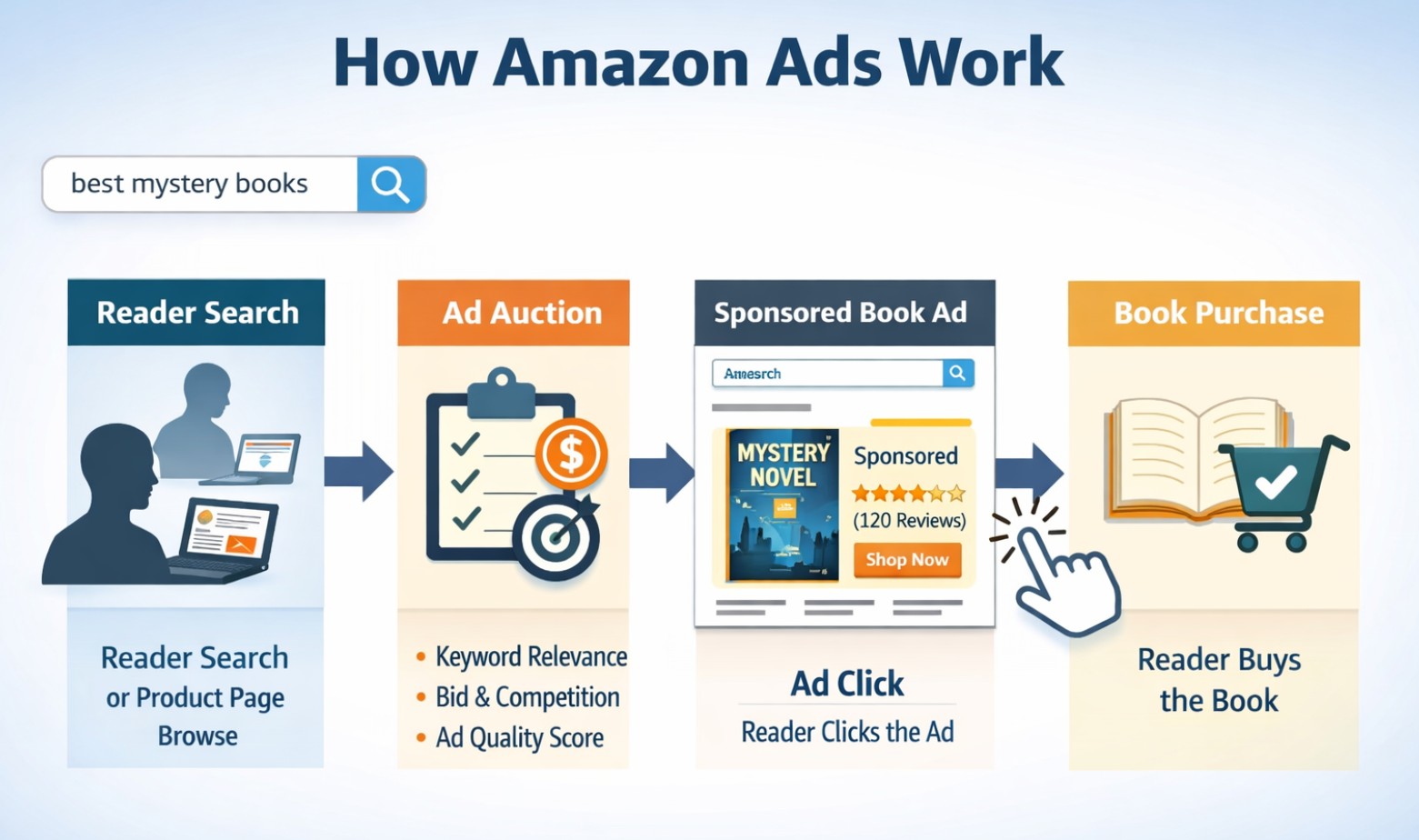
Amazon Ads process diagram
The process typically begins with keyword targeting. Authors choose search phrases or product targets that describe the type of readers they want to reach. When readers search for those terms or view related books, Amazon may display the sponsored listing.
If a reader clicks the ad, they are taken to the book’s product page where they can evaluate the cover, title, description, reviews, and pricing before deciding whether to purchase. This means advertising performance is closely connected to the strength of the book listing itself.
Because authors pay for clicks rather than impressions, the goal of most campaigns is not simply to generate traffic but to attract readers who are likely to convert into buyers. Strong targeting and relevant keywords help connect ads with readers whose interests match the book.
Types of Amazon Ads for Books
Amazon offers several advertising formats that authors can use to promote books inside the marketplace. Each format gives a different type of visibility and can support different marketing goals depending on the stage of the campaign.
Understanding these ad types helps authors choose the right structure for testing, launch support, visibility growth, or broader audience reach. The most common formats for books are Sponsored Products, Sponsored Brands, and Sponsored Display.
Sponsored Products
Sponsored Products are the most common Amazon Ads format for books. They usually appear in search results and on product pages, helping individual titles gain direct visibility in places where readers are already browsing and buying.
Sponsored Brands
Sponsored Brands give authors a way to promote a broader presence rather than only a single title. These ads can help highlight multiple books or strengthen brand visibility for authors with a growing catalog.
Sponsored Display
Sponsored Display ads are often used to extend visibility beyond standard keyword placements. They can help authors reach readers through audience and product-based targeting inside Amazon’s broader advertising environment.
The Amazon Ads Lifecycle
Successful Amazon Ads campaigns rarely work perfectly from the first day. Advertising usually develops through a series of stages where authors test targeting, collect performance data, and gradually refine campaigns based on real reader behavior.
Instead of expecting instant profitability, experienced advertisers treat campaigns as a learning process. Early campaigns help identify promising keywords, understand competition levels, and measure how well a book converts advertising traffic into actual sales.
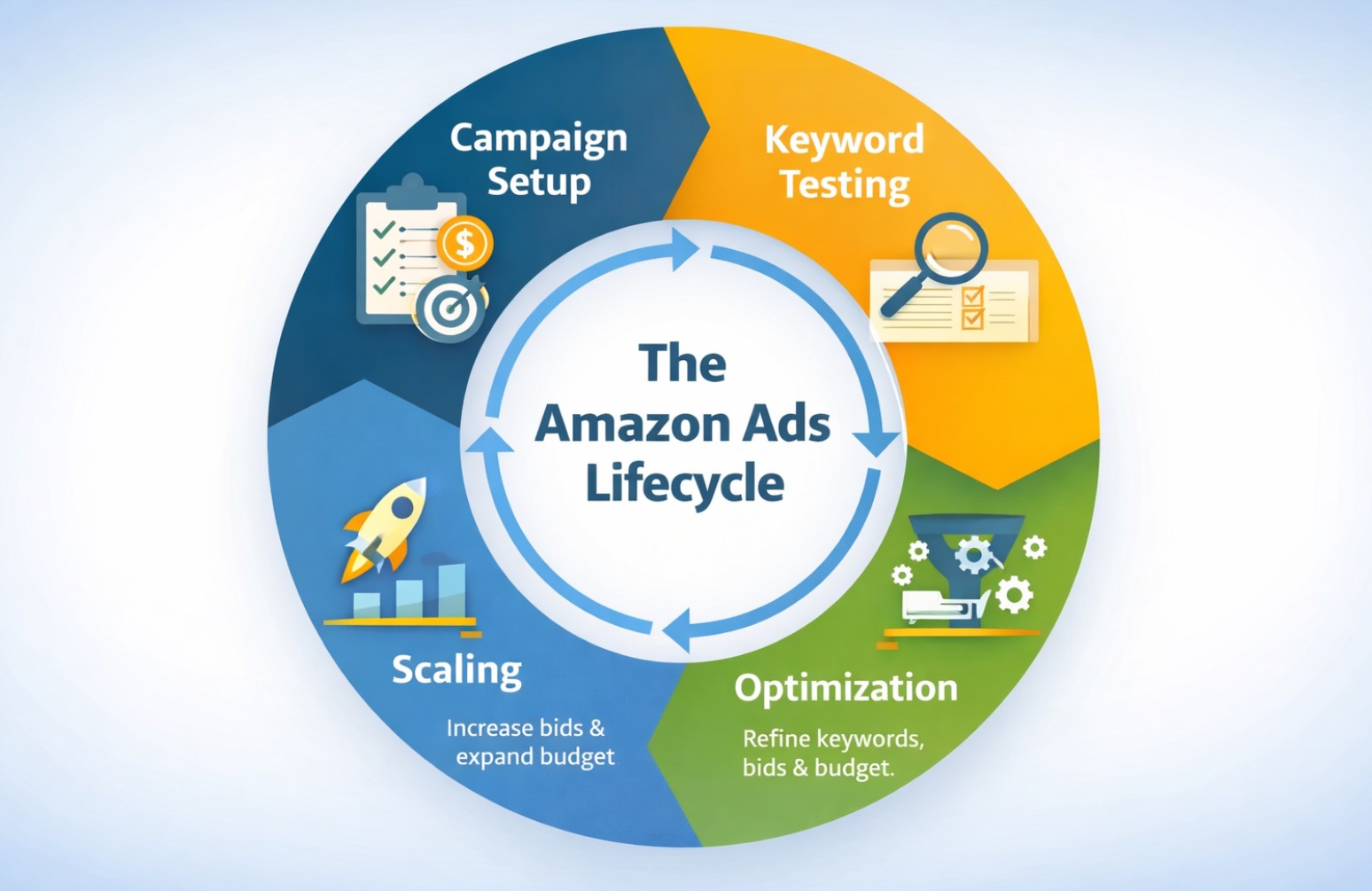
Amazon Ads lifecycle diagram
The first stage usually focuses on campaign setup and keyword testing. Authors launch campaigns with a range of keywords or targeting options in order to see which searches generate impressions and clicks.
As campaigns gather data, the next stage involves analyzing performance. Keywords that generate clicks, sales, or strong engagement signals may be expanded, while weaker targets can be reduced or removed.
Over time, this process leads to optimization and scaling. Campaigns become more efficient as authors increase bids on profitable keywords, adjust budgets, and focus advertising spend on the searches that produce the best results.
Key Amazon Ads Metrics Authors Must Understand
Amazon Ads campaigns generate a large amount of data, but only a few key metrics are essential for understanding whether a campaign is working effectively. These indicators help authors evaluate traffic quality, advertising costs, and the relationship between ad spending and book sales.
By monitoring these metrics regularly, authors can make more informed decisions about keyword targeting, bidding strategy, and campaign optimization. Instead of relying on guesses, performance data allows advertisers to identify which campaigns are profitable and which require adjustments.
| Metric | What It Measures | Why It Matters |
|---|---|---|
| ACOS | Advertising Cost of Sales — the percentage of ad spend compared to revenue generated from ads. | Helps determine whether a campaign is profitable or spending too much compared to the sales it produces. |
| CTR | Click-Through Rate — the percentage of people who click the ad after seeing it. | Shows whether the ad attracts reader attention and whether the cover, title, and targeting are appealing. |
| Conversion Rate | The percentage of ad clicks that result in an actual purchase. | Indicates how effectively the book listing converts visitors into buyers. |
| ROAS | Return on Ad Spend — the revenue generated for every dollar spent on advertising. | Helps evaluate the overall efficiency of advertising campaigns and long-term ad strategy. |
These metrics work together to explain campaign performance. A high CTR may indicate strong ad visibility, but if the conversion rate is low the book listing may require improvement. Similarly, a campaign may generate sales but still remain unprofitable if ACOS becomes too high.
For this reason, experienced advertisers rarely focus on only one number. Instead, they analyze several metrics together to understand how readers respond to ads and how campaigns can be improved over time.
Keyword Targeting in Amazon Ads
Keyword targeting is one of the core mechanisms behind Amazon Ads for books. When authors choose keywords for a campaign, they are essentially telling Amazon which reader searches should trigger the advertisement.
Strong keyword targeting helps connect ads with readers who are already looking for books on similar topics or in the same genre. When the keyword matches the reader’s intent, the ad is more likely to generate clicks and eventually lead to a purchase.
- Exact Match Keywords – Ads appear only when readers search for the exact phrase or a very close variation. This targeting provides strong control and is often used for proven keywords that already perform well.
- Phrase Match Keywords – Ads appear when the keyword phrase is included in a longer search query. This allows campaigns to capture a wider range of related searches while maintaining reasonable relevance.
- Broad Match Keywords – Ads may appear for a wider set of search variations that Amazon considers related. This format is often used during early campaign stages to discover new keyword opportunities.
- Category Targeting – Instead of targeting search terms, ads can appear within specific book categories. This approach helps authors reach readers who are browsing similar titles in the same niche.
- Product Targeting – Ads can also appear on product pages of specific books. This allows authors to place their titles directly next to competing or related books where interested readers are already evaluating similar options.
Effective keyword targeting often combines several of these approaches. Authors may begin with broader targeting to collect data, then gradually refine campaigns by focusing on keywords that generate consistent clicks and sales.
Over time, this process helps advertisers discover which search phrases truly match reader demand and which keywords should receive larger budgets or stronger bids.
Optimizing Amazon Ads Campaigns
Running Amazon Ads campaigns is only the first step. The real performance improvement usually comes from optimization, where authors analyze campaign data and adjust keywords, bids, and budgets to improve efficiency over time.
Most campaigns begin with a testing phase that collects performance data. Once the campaign generates enough impressions and clicks, authors can evaluate which keywords attract readers, which ones convert into sales, and which targets consume budget without producing meaningful results.
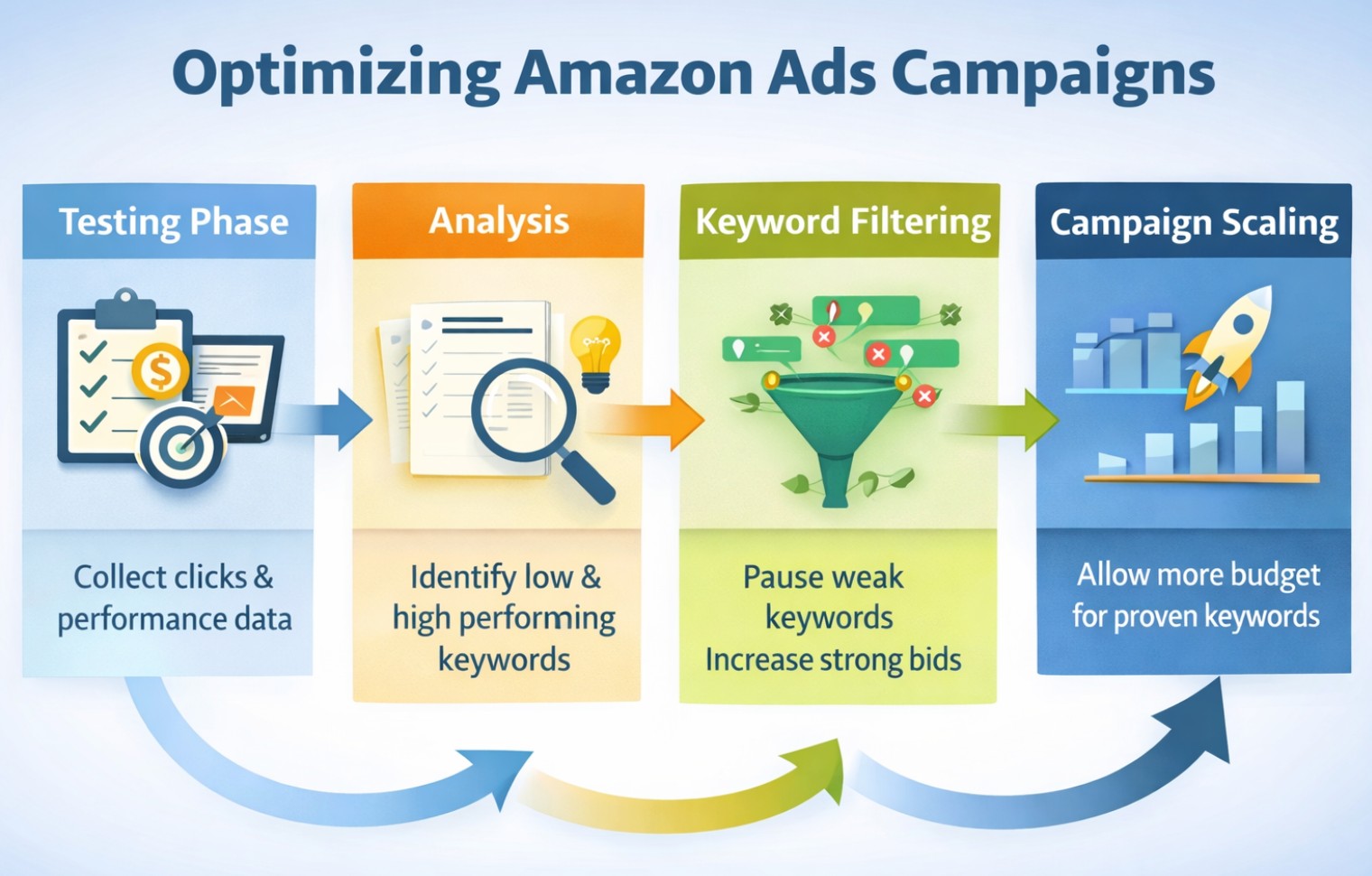
Amazon Ads optimization process diagram
Optimization often involves reducing bids on underperforming keywords, pausing targets that generate clicks without sales, and increasing bids on keywords that consistently produce conversions. This process gradually concentrates advertising spend on the most effective parts of the campaign.
Over time, optimized campaigns become more efficient because the budget is focused on search terms and product targets that attract readers with genuine purchase intent. This allows authors to improve visibility while controlling advertising costs.
Common Amazon Ads Problems
Even well-designed advertising campaigns can encounter performance problems. Authors often face situations where ads generate very few impressions, attract clicks without producing sales, or become too expensive to maintain profitably. Understanding these issues helps advertisers diagnose campaign performance and make more effective adjustments.
No Impressions
When ads receive very few impressions, the campaign may be targeting highly competitive keywords, using bids that are too low, or targeting searches with very little traffic.
No Clicks
If ads appear but readers do not click them, the cover, title, or targeting may not be attracting attention in crowded search results.
High ACOS
A high ACOS means advertising costs are consuming too much of the revenue generated by the campaign. This may happen when bids are too high or when conversion rates are weak.
Low Conversion
When clicks do not turn into purchases, the issue often lies in the book listing itself. Covers, descriptions, pricing, and reviews all influence whether readers decide to buy.
Amazon Ads Budget and Bidding Strategy
Budget and bidding decisions play a major role in how Amazon Ads campaigns perform. Even well-targeted keywords may fail to generate impressions or clicks if the campaign budget is too small or bids are not competitive enough for the marketplace.
Authors often adjust bids and budgets gradually as they gather performance data. Early campaigns may use conservative bids while testing keywords, while more established campaigns may increase bids for keywords that consistently generate profitable sales.
| Strategy | Goal | When to Use |
|---|---|---|
| Low Bids | Test keywords while minimizing advertising costs. | Early campaign stages when collecting initial data. |
| Moderate Bids | Maintain steady impressions and stable campaign performance. | After identifying keywords that generate consistent clicks. |
| Higher Bids | Increase visibility and capture more impressions for strong keywords. | When campaigns already show reliable conversion rates. |
| Budget Expansion | Allow successful campaigns to generate more traffic and sales. | When profitable keywords demonstrate stable performance. |
Because advertising competition varies across niches, there is no single ideal bid for every book. Some categories may require higher bids to win impressions, while others allow campaigns to perform well with smaller budgets.
Over time, authors typically refine their bidding strategy by increasing investment in profitable keywords and reducing spending on targets that do not generate meaningful results.
Amazon Ads as Part of a KDP Growth Strategy
Amazon Ads work best when they support a broader publishing and marketing strategy rather than functioning as an isolated promotion tool. Advertising can increase visibility, but long-term success usually depends on how well the book fits its niche and how effectively the listing converts reader interest into purchases.
Authors who treat advertising as part of a larger system often achieve better results. Instead of relying only on ads, they combine advertising with niche research, keyword targeting, launch preparation, and ongoing marketing efforts that help sustain visibility over time.
- Combine ads with keyword research – campaigns perform better when keywords reflect the real search phrases readers use while looking for books.
- Improve listing conversion – covers, titles, descriptions, and reviews influence whether ad clicks turn into sales.
- Use ads to test niche demand – advertising can help authors discover which topics, keywords, or book concepts attract stronger reader interest.
- Scale profitable keywords – once campaigns identify search phrases that consistently convert, authors can increase bids and budgets to expand visibility.
- Integrate ads with book launches – advertising can help generate early traffic and support visibility during the critical launch period of a new book.
Over time, this approach allows authors to use advertising more strategically. Instead of focusing only on short-term sales, campaigns can contribute to broader goals such as reader discovery, audience growth, and long-term visibility inside the Amazon marketplace.
When advertising, book positioning, and reader engagement work together, authors gain a clearer understanding of their market and can build a more sustainable publishing strategy.