

Book Marketing Checklist for Authors
Keep your book page accurate, reach the right readers and review what each campaign actually achieved. Use this checklist for one-time setup, weekly maintenance and monthly decisions.
Each section defines what to check and what counts as done. Start with the weakest step instead of adding more marketing tasks.
Book marketing checklist: setup, outreach, measurement, repeat
Confirm that the book serves a specific reader, check the public buying experience, prepare one relevant promotion channel and review the result. Repeat only the tasks that improve those steps. You do not need to maintain every social platform or run a promotion every week.
This checklist is for ongoing marketing of a current book or catalog. It is not a replacement for file production or a release calendar. If you are preparing a new publication, use the separate book launch checklist for deadline and release-day checks.
Source check: 17 October 2026. Linked KDP guidance supplies the platform conditions. The weekly routine, task examples and decision thresholds below are editorial working methods, not an Amazon approval process.
| Current situation | Priority | Leave until later |
|---|---|---|
| Book unavailable or listing inaccurate | Fix the buying experience | Paid traffic |
| Ready book, no clear audience | Define and test reader fit | Broad untargeted promotion |
| Relevant exposure, little interest | Check the hook, cover and description | Adding more channels |
| Orders, but costs exceed royalties | Review economics and attribution | Increasing the budget |
| A useful channel already exists | Document and improve the repeatable process | Replacing it simply because another tactic is fashionable |
1. Positioning and offer checklist
Complete once, revisit when the book or audience changes
- Write the primary reader in one sentence: genre preference, practical problem or reading situation.
- State the book's concrete promise without adding an outcome the contents cannot support.
- Identify comparable titles in the same format and marketplace to understand reader expectations.
- Choose the edition you will promote and verify its current price and royalty.
- For a series, identify the reading entry point and explain the order clearly.
- Choose the goal of the next test: paid orders, relevant discovery, reader feedback or another observable outcome.
Completion evidence: a short positioning note, the correct edition link and a named test goal. "Improve visibility" is not enough unless you define what you can observe and why it matters.
Check the promise with target readers
Ask what kind of book they expect from the cover and first description paragraph. Look for repeated misunderstandings, not only preferences. If an activity book looks advanced but contains beginner material, more advertising will not resolve that mismatch.
A Virtalibry cover or description poll can help organize this feedback. Use it to investigate presentation choices, not to claim a predicted sales lift. Save the actual question and the version tested so later comparisons remain meaningful.
Keep poll counts, ratings and comments separate. Use the description audit when approving wording for the reusable asset folder.
2. Book page and marketing asset checklist
Check the public page, not only your setup fields
- Open the intended marketplace and edition on phone and desktop.
- Verify that the buy option, title, author name, cover and price are correct.
- Check the description opening for a specific hook, genre or useful outcome.
- Read a representative sample for clarity, formatting and consistency with the promise.
- Review keywords and categories for relevance, not merely low competition.
- Check series and format links for mismatches.
- Verify your Author Central profile and book associations where available.
- If using A+ Content, confirm the content is accurate and appears for the intended edition, marketplace and language.
Use KDP's keyword guidance for metadata rules. Author Central and A+ Content can add useful context, but neither is a substitute for a readable description and sample. The official book promotion overview explains the available starting points.
Keep a small, reusable asset folder
- Save the approved cover image, a short description and a longer description.
- Save one representative excerpt or interior image you have the right to share.
- Keep the final buying link for each promoted marketplace and format.
- Record the date and wording of a temporary offer; remove it from assets when it ends.
- Name files clearly so an older cover or price is not sent by mistake.
Completion evidence: a dated listing check and an asset folder containing only usable versions. If a sample or edition link is still processing, mark it as pending and consult the current publishing timelines before assuming it has failed.
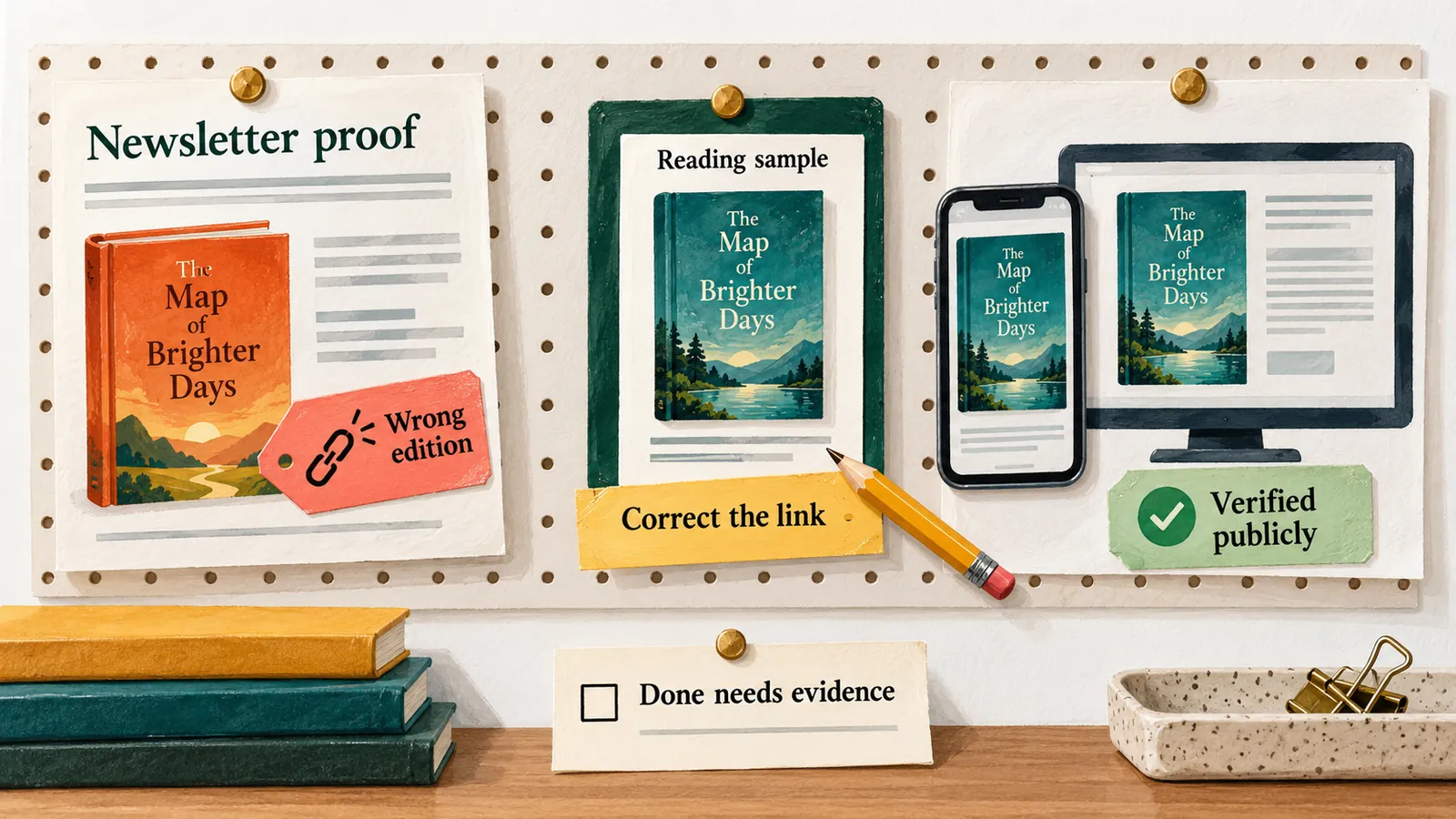
For each correction, keep the edition, marketplace, exact destination and version tested together. Record when the public result was checked, not only when the change was submitted. A newly saved description or image does not establish that a newsletter link now reaches the right edition.
3. Audience and outreach checklist
Choose a venue because its readers fit
- List a few relevant newsletters, partners or reader communities, with their actual submission rules.
- Record genre, format, price and placement eligibility, including any minimum existing public-review count. Eligibility is not permission to buy reviews.
- Check the total cost, timing, included deliverables and cancellation terms.
- Use designated promotion threads or obtain permission before posting in a community.
- Send author-news emails only to people who opted in, and maintain a working unsubscribe path.
- Personalize partner pitches around a useful contribution to their audience.
Completion evidence: one selected channel with a clear audience match and permission to use it. A list of hundreds of possible contacts is not evidence that you have reached a reader.
Keep reader invitations independent
If you offer an advance or review copy, do not require a public review or a particular rating. Do not offer cash, gifts or purchase reimbursement for a review. Check KDP's customer review guidance. Track private feedback and public opinions separately; neither should be treated as a purchased campaign deliverable.
4. Before every campaign: readiness checklist
- Write the audience, offer and channel in a single campaign note.
- Test the exact link that will appear in the message or placement.
- Check that the public price matches any advertised offer before the message is sent.
- For KDP Select promotions, verify eligibility and schedule restrictions in the current setup.
- Set a maximum acceptable spend, a review date and a responsible person.
- For ads, check bids, average daily budget, any budget-overdelivery settings and campaign end date.
- Record what you will measure and what you cannot attribute reliably.
- Choose a pause condition: unavailable book, broken destination, inaccurate offer or unacceptable cumulative spend.
Completion evidence: a ready-to-run message or campaign with verified details and a stop rule. Use the Amazon promotion guide when choosing between advertising, price promotions and listing improvements.
Use a simple campaign note
"Audience: beginner puzzle readers. Offer: large-print easy Sudoku with a clear interior sample. Channel: a permitted placement in a relevant newsletter. Goal: test paid interest. Evidence: delivery confirmation, available clicks, reported orders and royalties. Constraint: a fixed spending ceiling. Review: after the agreed observation period and reporting delay."
Replace the example with your own facts. Do not add a target sales number just to make the plan look precise when you have no basis for that forecast.
5. Weekly marketing routine
Pick a realistic time block. A solo author does not need a daily dashboard ritual for a campaign that runs once a month. Check more frequently when paid spend or a time-limited offer is active, and less frequently when nothing material is changing.
| Time | Task | Output |
|---|---|---|
| 10 minutes | Check active links, offers and availability | Issues fixed or campaigns paused |
| 15 minutes | Record spend, orders, royalties and available channel data | A dated update with reporting limitations |
| 15 minutes | Read genuine reader questions and useful feedback | One recurring objection or clarification to investigate |
| 20 minutes | Prepare the highest-priority outreach or improvement | One finished message, correction or test |
The timings are an example, not a productivity requirement. The useful output is a decision or completed task. Repeatedly refreshing sales rank without changing a decision is not a marketing routine.
Questions to answer before closing the review
- Did the planned activity actually run and reach the intended audience?
- Is the promotion still describing the book and price accurately?
- Are there costs or reader questions requiring immediate action?
- What single task matters most before the next review?
6. Monthly review: continue, revise or stop
Compare channels using the goal you set. Keep paid orders, free downloads and Kindle Unlimited reading in separate columns. Compare promotion spend with royalties, not the retail value of sales. Record overlapping promotions rather than pretending that each channel independently produced all the same orders.
For example, a $45 placement credited with five orders earning $3 each shows $15 in royalty against $45 of spend: a $30 shortfall before other costs. Credited orders are not proof of additional demand caused by the placement. If attribution is incomplete, the conclusion is less certain, not more favorable. These figures are illustrative, not customer results.
At the assumed $3 contribution, 15 additional paid orders would cover the $45 placement fee alone. Five credited orders do not meet that threshold, even before asking whether they were additional. Use the edition royalty calculator for a scoped estimate and the ROI example when including wider project costs.
- Continue an activity when its evidence and economics support another bounded test.
- Revise a task when a specific problem is visible, such as a misleading cover signal or wrong-marketplace link.
- Stop an activity when it repeatedly consumes money or time without reaching the stated goal.
- Archive outdated assets and remove expired offer wording.
- Set the next month's working-time and spending limits before booking new activity.
7. Keep a task board with evidence, not vague intentions
| Task | Owner and due date | Done when | Next review |
|---|---|---|---|
| Correct edition link | Author; before next send | The final message opens the intended marketplace and format | Before each campaign |
| Test description opening | Author; this week | Target readers can identify the book's promise accurately | After the feedback is reviewed |
| Evaluate a placement | Author; after reporting catches up | Cost, delivery, available clicks, orders and uncertainty recorded | Before rebooking |
Use simple statuses: planned, in progress, blocked and done. A blocked task should name the missing input. "Waiting for public sample" is useful; "marketing not ready" is not. Do not mark a task done because you edited a field if the correction has not yet appeared where readers see it.
Worked correction: the Kindle announcement opens the paperback. Keep the task in progress while correcting the link. Mark it done only after the final message, including redirects, opens the intended edition and marketplace on phone and desktop; save the checked URL and time. If availability still fails, keep the purchase announcement paused rather than closing the task.
8. Avoid turning the checklist into busywork
Remove tasks that do not serve your reader, goal or decision. Publishing daily on five platforms, rewriting metadata without evidence and chasing an arbitrary review target can consume the time needed to improve the actual offer. More completed boxes do not automatically mean better marketing.
For a new release, start with the Amazon launch strategy and then use the release checklist. For a ready book with no audience, use the first-sales experiment. Return here to maintain the parts that prove useful.
Use the long-term strategy to decide which catalog titles and channels deserve that recurring work. This checklist executes the decision; it should not choose a new strategy every week.
Explore the book marketing guides to connect this task with launch planning, audience building and promotion.
Frequently asked questions
What should a book marketing checklist include?
Include reader positioning, public listing checks, usable marketing assets, permission-based outreach, campaign limits and a recurring review of results. Give each task an owner and observable completion evidence rather than using vague goals such as improve visibility.
How is this different from a book launch checklist?
A launch checklist focuses on preparing and releasing a book. This marketing checklist maintains the audience, offer, promotion assets and measurement process after publication. Some checks overlap, but the recurring work does not end on release day.
How often should I review my book marketing?
Use a manageable weekly review for current activity and a monthly decision on what to continue, revise or stop. Check more often when paid spend or a temporary offer is active. The schedule should match the actual risk and volume of activity.
Can I use the checklist without paying for ads?
Yes. Prioritize a clear book page, a relevant audience and permitted outreach. Set a working-time limit even when there is no paid budget, and measure completed placements or useful reader response rather than counting social posts alone.
What counts as a completed marketing task?
Completion requires evidence that the intended result is in place. A corrected buying link should open the right edition; a listing change should be verified publicly; a campaign review should record costs, results and limitations. Saving a setup field is not always the finish.
Which marketing metrics should I record?
Record the campaign goal, dates, cost, delivery, available clicks, reported paid orders and royalties. Keep free downloads and subscription reading separate. Note reporting delays and attribution limits instead of assigning every order to one campaign.