
What Is KDP Keyword Research
KDP keyword research is the process authors use to identify the search phrases readers type into Amazon when looking for books. These keywords help Amazon understand what a book is about and determine when it should appear in search results. When keywords match real reader searches, books have a much better chance of being discovered.
On Amazon, discoverability is strongly influenced by search behavior. Readers rarely browse randomly through categories. Instead, they search for specific phrases such as “mindfulness workbook for beginners”, “large print sudoku for seniors”, or “Mediterranean diet cookbook for beginners”. KDP keyword research focuses on identifying these phrases and understanding which ones represent real reader demand.
When authors choose keywords strategically, they help Amazon connect their book with the right audience. Instead of competing for extremely broad terms, keyword research allows authors to target more specific phrases that better reflect the reader’s intent and the exact type of book being offered.
What Keyword Research Helps Authors Do
- Help Amazon understand what the book is about
- Match the book with relevant reader search queries
- Reach niche audiences looking for specific topics
- Improve discoverability in Amazon search results
- Support stronger positioning within competitive niches
Because keywords influence how Amazon connects books with readers, keyword research becomes one of the most important steps in the KDP publishing process. Authors who understand how keyword targeting works are better prepared to position their books, reach the right readers, and improve long-term discoverability on the platform.
How Amazon Book Search Works
Amazon’s search system connects readers with books using keywords and search phrases. When a reader types a query into the Amazon search bar, the platform analyzes the words in the search phrase and attempts to find books whose metadata matches that intent. Keywords therefore act as signals that help Amazon understand what a book is about.
These signals come from several parts of a book listing, including the title, subtitle, description, categories, and the seven keyword fields available inside the KDP publishing dashboard. When these elements are aligned with real reader search phrases, Amazon can more easily match the book with relevant search results.
Search visibility does not depend only on keywords. Amazon also considers factors such as clicks, sales, and reader engagement. However, keyword targeting is the first step that allows a book to enter the search ecosystem and start appearing in relevant results.
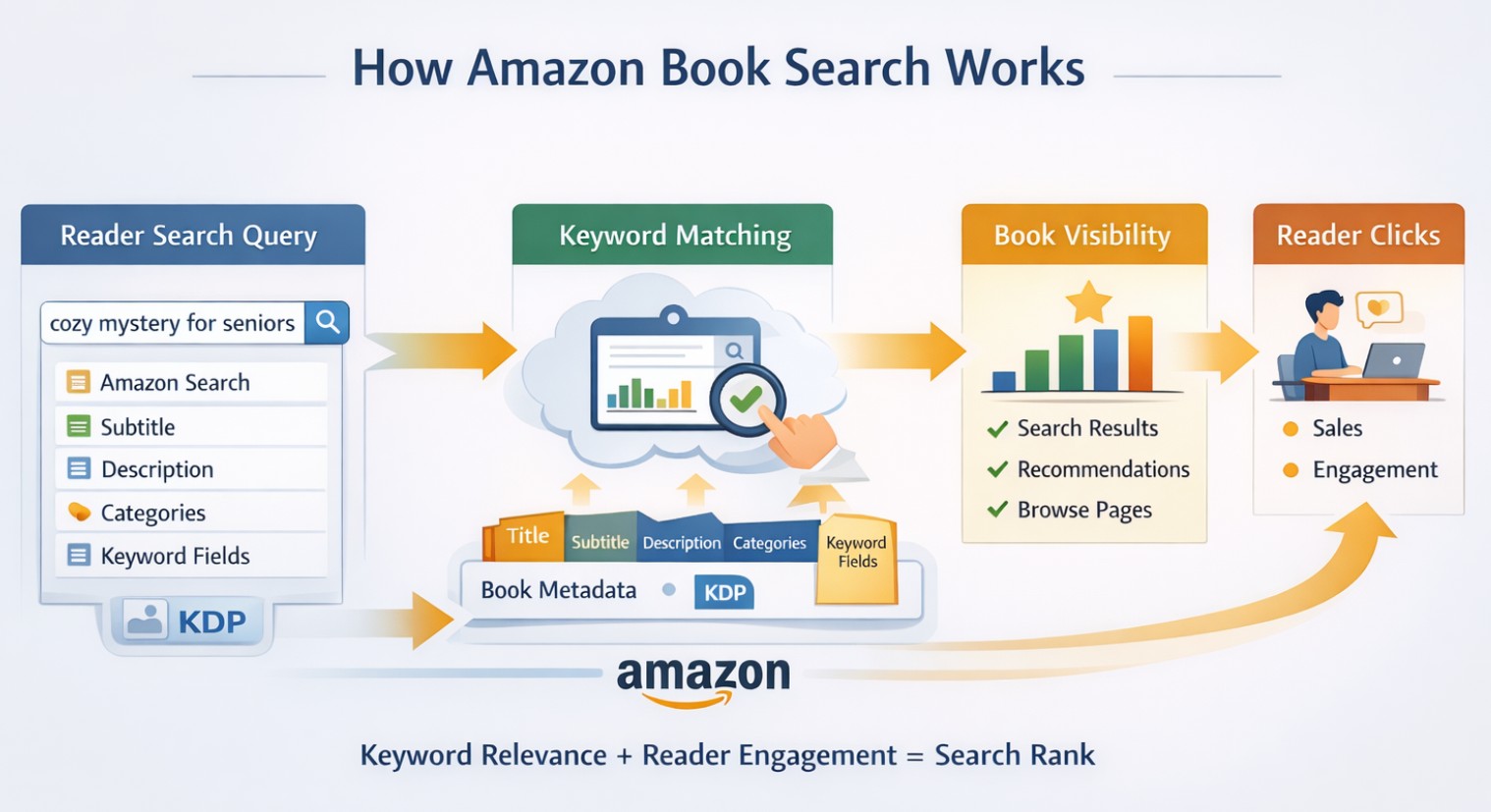
Amazon book search system diagram
The KDP Keyword Research Process
KDP keyword research usually follows a structured workflow that helps authors discover search phrases readers are already using on Amazon. Instead of guessing which keywords might work, authors analyze search suggestions, competing books, and niche language to identify phrases that reflect real reader intent.
This process combines keyword discovery, demand evaluation, and competition analysis. By following these steps, authors can select keyword phrases that not only describe the book accurately but also improve the chances that Amazon will show the book to interested readers.
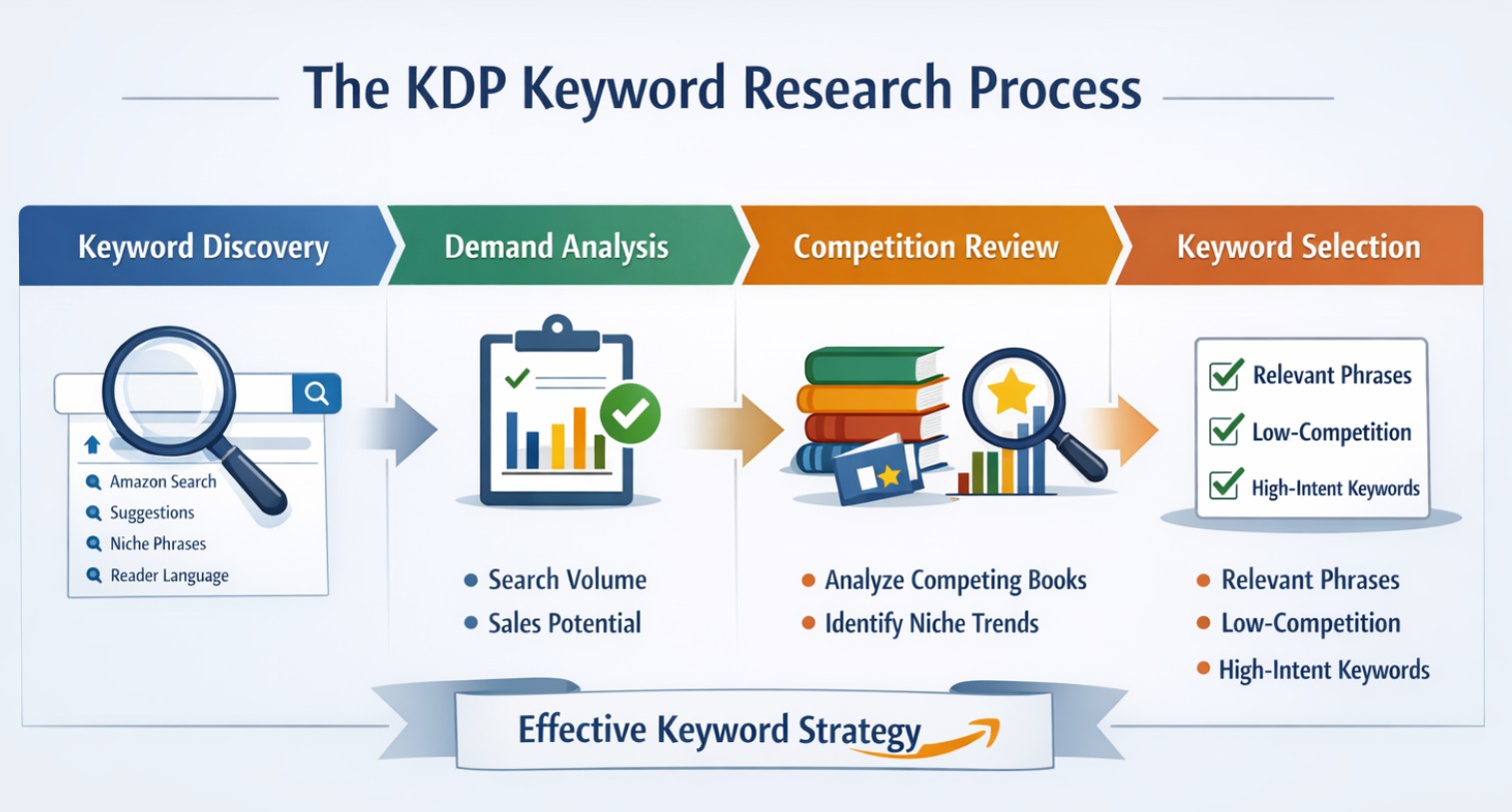
KDP keyword research process diagram
Typical Steps in Keyword Research
- Identify search phrases readers use when looking for similar books
- Analyze Amazon autocomplete suggestions and related search terms
- Study competing books and the keywords they appear to target
- Evaluate whether the keyword reflects real reader demand
- Select keyword phrases that clearly describe the book and its niche
Authors who follow a structured keyword research process usually make stronger publishing decisions. Instead of relying on random phrases, they choose keywords that reflect how readers actually search for books within a specific niche or topic.
Where Authors Find KDP Keywords
Keyword discovery is the first step of effective KDP keyword research. Instead of guessing phrases randomly, experienced authors look for keywords in places where reader search behavior is already visible. Amazon search suggestions, niche competitors, keyword tools, and AI-assisted generators can all reveal valuable search phrases.
Different methods can uncover different types of keyword opportunities. Some techniques focus on discovering real search phrases used by readers, while others help generate variations or refine keyword lists before adding them to the KDP publishing fields.
How to Find KDP Keywords
Learn practical methods for discovering keyword ideas using Amazon search suggestions, niche phrases, and reader search patterns.
Explore keyword discovery methodsKeyword Research Without Tools
Discover how authors perform keyword research directly inside Amazon using autocomplete suggestions, categories, and competitor listings.
Learn manual keyword researchAI Book Keyword Generator
Generate keyword ideas using AI tools that help expand search phrase variations based on your book topic.
Try AI keyword generationKDP Keyword Cleaner
Clean and format keyword lists before entering them into the KDP dashboard to avoid duplicates and formatting problems.
Clean your keyword listCombining several keyword discovery methods usually produces stronger results. Authors often start with Amazon search suggestions, expand ideas using AI tools or keyword generators, and then refine the final keyword list before adding it to the seven keyword fields available in the KDP publishing interface.
Amazon KDP Keyword Rules
Amazon provides specific guidelines for the keywords authors enter during the KDP publishing process. Following these rules helps Amazon understand the book correctly and prevents issues that may reduce discoverability or cause keywords to be ignored by the system.
The platform allows authors to enter up to seven keyword fields, but these fields must follow certain formatting and policy guidelines. Understanding these rules ensures that keyword research efforts translate into effective metadata rather than wasted keyword space.
| Keyword Rule | Explanation |
|---|---|
| Use phrases instead of single words | Amazon recommends entering keyword phrases rather than individual words. Phrases better reflect real reader searches. |
| Avoid repeating title words | Words already present in the title or subtitle usually do not need to be repeated in keyword fields. |
| No competitor names | Using other authors’ names, book titles, or trademarks in keyword fields is against Amazon policy. |
| Avoid misleading phrases | Keywords should accurately describe the book. Misleading phrases can reduce reader trust and may violate guidelines. |
| Do not repeat categories | Category names already define part of the book’s positioning, so repeating them in keyword fields usually adds little value. |
| Use natural search phrases | Keywords should resemble real reader search behavior rather than artificial or overly technical phrasing. |
When keywords follow Amazon’s formatting and policy guidelines, they are more likely to be interpreted correctly by the search system. This helps Amazon match books with relevant reader searches and improves the chances that the listing will appear in appropriate search results.
For a deeper explanation of keyword restrictions, formatting rules, and practical examples, you can review the full guide onAmazon KDP keyword rules.
Common KDP Keyword Mistakes
Even when authors understand the importance of keywords, mistakes in keyword selection or formatting can reduce the effectiveness of keyword research. Some problems occur because authors misunderstand how Amazon search works, while others appear when keyword fields are used inefficiently.
Avoiding these common mistakes helps authors make better use of the seven keyword fields available in KDP and improves the chances that the book will appear in relevant reader searches.
- Targeting extremely broad keywords.Keywords such as “romance” or “cookbook” are highly competitive and rarely help new books gain visibility. More specific phrases usually perform better.
- Ignoring reader search intent.Keywords should reflect how readers actually search for books, not how authors describe them internally.
- Repeating words already used in the title.Repeating the same words across the title, subtitle, and keyword fields wastes valuable keyword space.
- Using irrelevant or misleading keywords.Keywords that do not match the content of the book may attract the wrong audience and reduce conversion rates.
- Overcomplicating keyword phrases.Extremely long or unnatural keyword combinations often do not match real reader search behavior.
Many keyword problems appear when authors treat keyword research as a one-time step rather than an ongoing process. Reviewing keyword performance, analyzing competitor listings, and refining keyword phrases over time can improve discoverability.
A deeper explanation of these problems and how to avoid them can be found in the guide oncommon KDP keyword mistakes.
How Many Keywords KDP Allows
Amazon KDP allows authors to enter up to seven keyword fields during the publishing process. These keyword fields help Amazon understand the book and determine when it should appear in search results for relevant reader queries.
Each keyword field can contain a phrase rather than a single word. This allows authors to target more specific search expressions that reflect how readers actually search for books on Amazon.
| Keyword Field | Typical Purpose |
|---|---|
| Keyword Field 1 | Main niche phrase describing the core topic of the book. |
| Keyword Field 2 | A variation of the main topic or a closely related niche. |
| Keyword Field 3 | A phrase reflecting reader intent or a problem the book solves. |
| Keyword Field 4 | An alternative search phrase readers may use. |
| Keyword Field 5 | A long-tail keyword describing a specific audience or use case. |
| Keyword Field 6 | A niche variation related to the main subject of the book. |
| Keyword Field 7 | An additional long-tail phrase capturing another search scenario. |
Because the number of keyword fields is limited, authors usually benefit from choosing phrases that describe the book clearly while covering different variations of reader search behavior.
For a detailed explanation of keyword fields, formatting recommendations, and strategy tips, you can review the guide onhow many keywords Amazon KDP allows.
KDP Keyword Examples
One of the easiest ways to understand KDP keyword research is to look at real keyword phrase examples. Instead of targeting single words, most successful Amazon books rely on longer search phrases that describe the exact type of book a reader is looking for.
These phrases often combine the topic of the book with the audience, format, or goal the reader has in mind. Such keyword phrases are usually called “long-tail keywords” because they represent more specific search behavior.
| Book Type | Example Keyword Phrase |
|---|---|
| Self-Help | mindfulness workbook for beginners |
| Puzzle Books | large print sudoku for seniors |
| Romance | enemies to lovers romance novel |
| Cookbooks | mediterranean diet cookbook for beginners |
| Productivity | time management planner for entrepreneurs |
| Children’s Activity Books | maze activity book for kids ages 6-8 |
These examples illustrate how keyword phrases usually combine several elements: the topic of the book, the intended reader, and sometimes the specific format or difficulty level. This makes the search phrase much more precise than a single broad keyword.
For more keyword ideas across different niches and publishing categories, explore the collection ofKDP keyword examplesthat show how authors target different audiences and search intents.
Keyword Strategy for Different Niches
KDP keyword research is not identical for every type of book. Different niches attract different reader language, search habits, and levels of competition. A keyword phrase that works well for a puzzle book may be very different from the type of phrase readers use for self-help, romance, or cookbook titles.
Because of this, authors usually get stronger results when keyword strategy is adapted to the niche rather than treated as a universal formula. Niche-specific keyword research helps authors target the language real readers use inside each category.
Puzzle Book Keywords
Explore keyword strategies for puzzle books such as Sudoku, word search, crossword, and other activity-based publishing niches.
Explore puzzle book keyword ideasSelf-Help Book Keywords
Learn how keyword research works in self-help niches where readers often search for specific outcomes, problems, or personal improvement goals.
Explore self-help keyword strategyRomance Book Keywords
Romance readers often search using tropes, emotional dynamics, and subgenre signals that make keyword selection very niche-specific.
Explore romance keyword ideasCookbook Keywords
Cookbook keyword research often reflects diet type, cooking method, audience, and practical goals such as beginner-friendly or quick-meal recipes.
Explore cookbook keyword strategyWhen keyword strategy reflects the language readers use inside a specific niche, books are more likely to appear in relevant searches and attract the audience most interested in that topic or genre.
How Keyword Research Connects With KDP Strategy
Keyword research does not work in isolation. On Amazon KDP, keywords interact with other elements of a book listing, including categories, metadata, positioning, and reader behavior. When these elements support each other, Amazon can more clearly understand the book and match it with relevant reader searches.
This means keyword research should be part of a broader publishing strategy rather than treated as a single step during the upload process. Authors who align keyword targeting with niche selection, categories, and reader expectations usually create stronger discoverability signals.
How Keywords Support KDP Discoverability
- Niche positioning.Keywords help define the niche where the book belongs and signal the topic to Amazon's search system.
- Search visibility.Well-chosen keyword phrases allow the book to appear in search results when readers look for related topics.
- Category alignment.Keywords and categories reinforce each other and help Amazon understand the book's market placement.
- Reader targeting.Specific keyword phrases help attract readers who are actively searching for that type of content.
- Long-term discoverability.When keywords match real reader searches, books can continue appearing in relevant results long after launch.
Authors who integrate keyword research with niche analysis, category selection, and listing optimization usually create stronger signals for Amazon's recommendation and search systems. This alignment improves the chances that the book will reach readers who are genuinely interested in its topic.