
Understanding KDP Niche Research
KDP niche research is the process of evaluating book opportunities on Amazon before publishing. Instead of choosing a topic randomly, authors study reader demand, existing competition, and how similar books perform in the marketplace. This helps determine whether a book idea has a realistic chance to attract readers and generate sales.
Many publishing challenges begin with niche selection. A book can be well written and professionally designed, yet still struggle to gain visibility if it enters a market that is overcrowded or lacks real buyer demand. Niche research helps authors avoid these situations by identifying stronger opportunities earlier in the publishing process.
On Amazon, niches are closely connected to how books are discovered. Reader searches, categories, keywords, and recommendation systems all influence which books appear in front of potential buyers. Understanding niche structure helps authors position their books more effectively within these discovery systems.
Because of this, niche research is often one of the most important steps in a successful KDP strategy. Authors who analyze demand, competition, and reader intent before publishing usually make stronger decisions about topics, positioning, and long-term marketing.
Why KDP Niche Research Matters
Niche research helps authors evaluate book opportunities before investing time in writing, design, and promotion. Without research, publishing often becomes guesswork. With research, authors can better understand reader demand, competition, and the likelihood that a new book can gain visibility in the Amazon marketplace.
| Publishing Decision | Without Niche Research | With Niche Research |
|---|---|---|
| Book topic | Chosen randomly or based on personal assumptions | Selected based on visible reader demand |
| Competition level | Unknown until after publishing | Evaluated before writing the book |
| Reader expectations | Often unclear or misunderstood | Studied through existing books in the niche |
| Discoverability | Difficult because positioning is weak | Improved through clearer niche positioning |
| Publishing strategy | Reactive decisions after launch | Strategic planning before publishing |
By studying demand, competition, and reader behavior before publishing, authors can make stronger decisions about which ideas to pursue. This reduces the risk of launching books into weak or overcrowded niches and improves the chances that a book will reach the readers who are most likely to enjoy it.
The KDP Niche Research Process
KDP niche research usually follows a structured process that helps authors evaluate whether a book idea has real market potential. Instead of guessing which topics may succeed, authors analyze several signals that reveal how active a niche is and how difficult it may be to compete.
This process combines demand analysis, competition evaluation, and market validation. By following these steps, authors can identify niches where readers are actively buying books while still leaving room for new titles to enter the market.
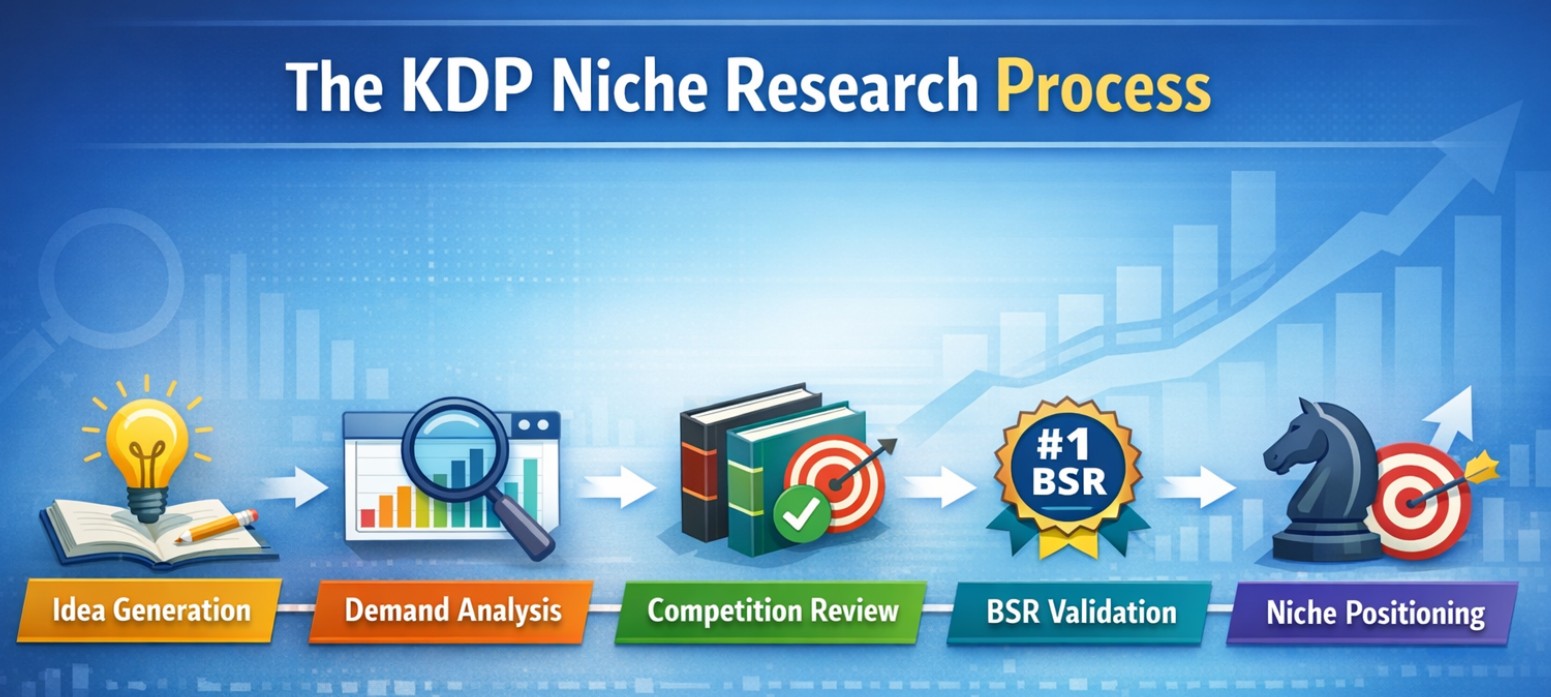
KDP niche research process diagram
The process often begins with identifying a potential topic or niche idea. Authors then explore whether readers actively search for books on that topic and examine existing titles that already serve that audience.
Next comes competition analysis. By reviewing similar books, their positioning, and their sales performance, authors can estimate how difficult it may be for a new book to compete within the niche.
Finally, BSR patterns and category signals help validate the niche. When books in the niche show consistent sales activity and the competition remains manageable, the idea may represent a stronger publishing opportunity.
Types of KDP Niches
Amazon publishing includes many different types of book niches. Some niches focus on simple formats such as notebooks and journals, while others involve puzzle books, fiction stories, or specialized nonfiction topics. Each type of niche has its own demand patterns, competition levels, and publishing strategies.
Understanding these categories helps authors explore opportunities more systematically and identify the publishing models that best match their skills, interests, and long-term goals.
Low-Content Book Niches
Low-content niches include notebooks, journals, planners, and other simple interior formats. These books are popular because they can be produced quickly and cover many specialized topics or audiences.
Puzzle Book Niches
Puzzle niches include Sudoku, word search, crossword, maze, and other activity books. These categories often perform well on Amazon because readers regularly buy new puzzle books after finishing previous ones.
Fiction Niches
Fiction niches include genres such as romance, fantasy, thriller, and many specialized subgenres. In fiction, niche research often focuses on reader expectations, tropes, and subgenre positioning.
Nonfiction Niches
Nonfiction niches cover a wide range of topics including self-help, productivity, health, cooking, and personal development. These niches often rely heavily on solving specific reader problems or providing practical guidance.
Examples of Popular KDP Niche Categories
KDP niche research often begins with exploring broader publishing categories. These categories include many specialized niches that attract different types of readers. Understanding these groups helps authors discover opportunities and narrow their focus to more specific book ideas.
The categories below represent some of the most common areas where authors publish books on Amazon. Each category contains many sub-niches that may vary in demand, competition, and publishing strategy.
| Category | Example Niches | Typical Audience |
|---|---|---|
| Puzzle Books | Sudoku, Word Search, Crossword, Maze, Cryptogram | Readers looking for entertainment and mental challenges |
| Low-Content Books | Notebooks, Journals, Planners, Logbooks | Students, professionals, and hobby audiences |
| Fiction | Romance, Fantasy, Mystery, Thriller | Genre readers seeking storytelling and entertainment |
| Self-Help | Productivity, Mindset, Habits, Personal Growth | Readers seeking improvement or life guidance |
| Cookbooks | Keto, Mediterranean, Vegan, Air Fryer, Quick Meals | Home cooks looking for practical recipes |
| Activity Books | Kids activities, educational puzzles, learning games | Children, parents, and educators |
Each of these categories contains dozens or even hundreds of smaller niches. Successful authors often explore these subcategories carefully to identify opportunities where reader demand exists but competition remains manageable.
Low-Content Book Niches
Low-content books represent one of the most accessible areas of Amazon publishing. These books usually contain simple page structures and are designed for repeated daily use rather than long reading sessions.
Because the interior layouts are often simple, authors can explore many specialized topics and audiences. Successful low-content niches usually focus on specific user needs such as planning, tracking, journaling, or structured note-taking.
Notebook Niches
Notebook niches often target specific audiences such as students, professionals, hobbyists, or themed communities. Examples include composition notebooks, subject notebooks, and specialized writing notebooks.
Journal Niches
Journals usually focus on reflection, tracking, or personal development. Examples include gratitude journals, wellness journals, habit journals, and self-reflection notebooks.
Planner Niches
Planners help readers organize tasks, schedules, or goals. Popular niches include productivity planners, fitness planners, budgeting planners, and student planners.
Although low-content books are simple in structure, niche positioning still plays a major role in their success. Authors often find stronger opportunities by targeting specific audiences, professions, hobbies, or lifestyle themes rather than creating very generic notebooks.
Puzzle Book Niches
Puzzle books represent one of the most active categories in the KDP marketplace. Readers who enjoy puzzles often purchase multiple books, which makes these niches especially attractive for authors who want to publish series or collections.
Within the puzzle category there are many specialized niches. These niches can be defined by puzzle type, difficulty level, audience age, or thematic focus. Understanding these variations helps authors position puzzle books more effectively.
Sudoku Books
Sudoku books are one of the most established puzzle niches. Authors often create variations such as easy Sudoku, hard Sudoku, kids Sudoku, or large print editions.
Word Search Books
Word search puzzles are widely popular across many audiences. Niches can focus on themes, difficulty levels, kids editions, or large print formats.
Crossword Books
Crossword books target readers who enjoy vocabulary and word-based challenges. These niches often include beginner, themed, kids, and large print crossword puzzles.
Maze Books
Maze books are especially popular for children and educational activities. Some niches also focus on themed mazes or more complex puzzles for adults.
Cryptogram Books
Cryptograms challenge readers to decode hidden messages. Niches often include themed quotes, motivational sayings, or educational puzzles.
Word Puzzle Variations
Additional puzzle niches include word scramble puzzles, missing vowels puzzles, kakuro, matching words puzzles, and other logic-based challenges.
Puzzle niches often perform well when authors specialize in a specific puzzle type and build a recognizable series. Clear difficulty levels, audience targeting, and thematic positioning can help puzzle books stand out in competitive marketplaces.
Fiction Book Niches
Fiction publishing on Amazon is built around genres and subgenres that attract specific groups of readers. Each fiction niche has its own expectations, storytelling conventions, and audience preferences that influence how books are discovered and marketed.
Successful fiction niche research often focuses on identifying reader expectations, understanding popular tropes, and studying how bestselling books are positioned within a particular genre.
Romance Niches
Romance is one of the largest fiction markets on Amazon. The genre contains many specialized niches such as contemporary romance, paranormal romance, billionaire romance, and small-town romance.
Fantasy Niches
Fantasy niches include epic fantasy, urban fantasy, dark fantasy, and many hybrid subgenres. Readers often look for specific world-building styles, themes, and character archetypes.
Thriller and Mystery Niches
Thriller and mystery niches focus on suspense-driven storytelling. Examples include psychological thrillers, detective series, crime fiction, and investigative mysteries.
In fiction publishing, niche positioning often depends on reader expectations and genre conventions. Authors who clearly understand the themes, tropes, and audience of a specific fiction niche usually build stronger series and more recognizable author brands.
Nonfiction Book Niches
Nonfiction niches on Amazon focus on solving specific problems or helping readers achieve a particular goal. Unlike fiction, where storytelling drives interest, nonfiction books usually succeed when they address a clear reader need or provide practical guidance.
Many nonfiction niches are built around personal improvement, skills, health, productivity, or lifestyle topics. Authors often succeed when they focus on a specific audience and a clearly defined outcome that the reader wants to achieve.
Self-Help Niches
Self-help books focus on personal development topics such as mindset, confidence, anxiety management, motivation, and habit building.
Productivity Niches
Productivity books help readers improve time management, organization, focus, and goal achievement in work or daily life.
Personal Growth Niches
Personal growth niches often overlap with mindset, motivation, discipline, and life improvement topics that help readers develop new perspectives and habits.
Cookbook Niches
Cookbook niches are often defined by diet types, cooking methods, or cultural cuisines such as keto, vegan, Mediterranean, air fryer, or regional recipes.
In nonfiction publishing, niche success often depends on how clearly the book communicates its value to readers. Specific topics, targeted audiences, and practical outcomes usually perform better than broad or vague themes.
How to Validate a KDP Niche
Discovering an interesting book idea is only the first step. Before investing time in writing, design, and promotion, authors should validate whether a niche has real market potential on Amazon.
Niche validation helps determine whether readers are actively buying books in a particular topic and whether a new book has a realistic opportunity to compete. This process usually involves analyzing demand, competition, and how existing books perform in search results.
| Validation Factor | What to Analyze | Why It Matters |
|---|---|---|
| Search Demand | Look for niche-related keywords in Amazon search and observe whether many books appear for those terms. | If readers frequently search for a topic, it indicates consistent demand and a larger potential audience. |
| BSR Performance | Examine the Best Seller Rank of top books in the niche. Lower BSR numbers usually indicate stronger sales activity. | BSR helps estimate whether books in the niche are selling regularly or only occasionally. |
| Competition Strength | Review covers, titles, and descriptions of competing books to evaluate how professional and competitive the listings are. | Highly optimized competitors may require stronger positioning to stand out. |
| Review Counts | Check how many reviews bestselling books in the niche have. Large review numbers often indicate established competitors. | Review volume can reveal how mature and competitive the niche already is. |
| Sub-Niche Opportunities | Look for smaller variations of the niche, such as audience segments, themes, or difficulty levels. | Sub-niches often allow new books to compete more effectively than broad categories. |
Authors often find the best opportunities where demand is visible but competition is not overwhelmingly strong. Niches where several books sell consistently, yet new books still appear in the results, may indicate a healthy and active marketplace.
Validation does not guarantee success, but it helps reduce uncertainty. By analyzing demand, competition, and reader behavior before publishing, authors can make more informed decisions about which ideas deserve further development.
Common KDP Niche Research Mistakes
Niche research can significantly improve publishing decisions, but many authors still make mistakes when evaluating book opportunities on Amazon. These mistakes often lead to weak positioning, unrealistic expectations, or publishing into niches that are difficult to compete in.
Understanding common niche research errors can help authors approach the process more strategically and avoid problems before investing time in writing and launching a book.
- Choosing niches based only on popularity.High demand niches can look attractive, but they are often highly competitive. Without differentiation or strong positioning, new books may struggle to gain visibility.
- Looking only for low competition.Extremely low competition can sometimes signal weak reader demand. Niches with very few competing books may also have very few buyers.
- Ignoring reader intent.Successful niches usually reflect a specific reader need, problem, or experience. Books that do not match what readers actually expect in a niche often perform poorly.
- Underestimating listing quality.Strong covers, clear titles, and persuasive descriptions can greatly influence performance. Even a good niche can be difficult if the listing does not attract attention.
- Skipping validation before publishing.Some authors begin writing immediately after choosing an idea. Researching demand, BSR, and competitor positioning beforehand can prevent many common publishing mistakes.
Avoiding these mistakes does not guarantee success, but it increases the chances that a book enters a niche with real reader demand and a realistic opportunity to compete.
Authors who combine niche research with keyword strategy, positioning, and thoughtful marketing decisions usually build stronger foundations for long-term publishing results.
Improving Your KDP Niche Research Skills
Niche research is not a single step in the publishing process. It is a skill that improves with experience as authors learn how to interpret reader demand, analyze competing books, and recognize patterns across Amazon search results.
Many early publishing problems happen because authors choose niches without carefully studying the market. Learning to recognize common research errors can help prevent these situations and make niche selection much more strategic. If you want to explore this topic in more detail, you can review the most frequent KDP niche research mistakes that new authors often encounter.
Another important part of niche validation is understanding how competing books perform inside a category. Studying book listings, covers, reviews, and Best Seller Rank patterns can reveal whether a niche is dominated by established competitors or still open to new entries. A deeper explanation of this process can be found in the guide on how to analyze book competition.
When niche research, competition analysis, and reader demand are evaluated together, authors can make much stronger publishing decisions. This approach helps identify book ideas that have a clearer path to visibility, reader interest, and long-term success on Amazon.