

How to Build an Author Platform
Give the right readers a clear place to discover your books, an optional way to stay connected and a reason to return. Start with a small system you can maintain rather than a large collection of accounts.
Use genre-specific examples, a minimum setup and a 90-day plan to connect your home page, email list and chosen discovery channel.
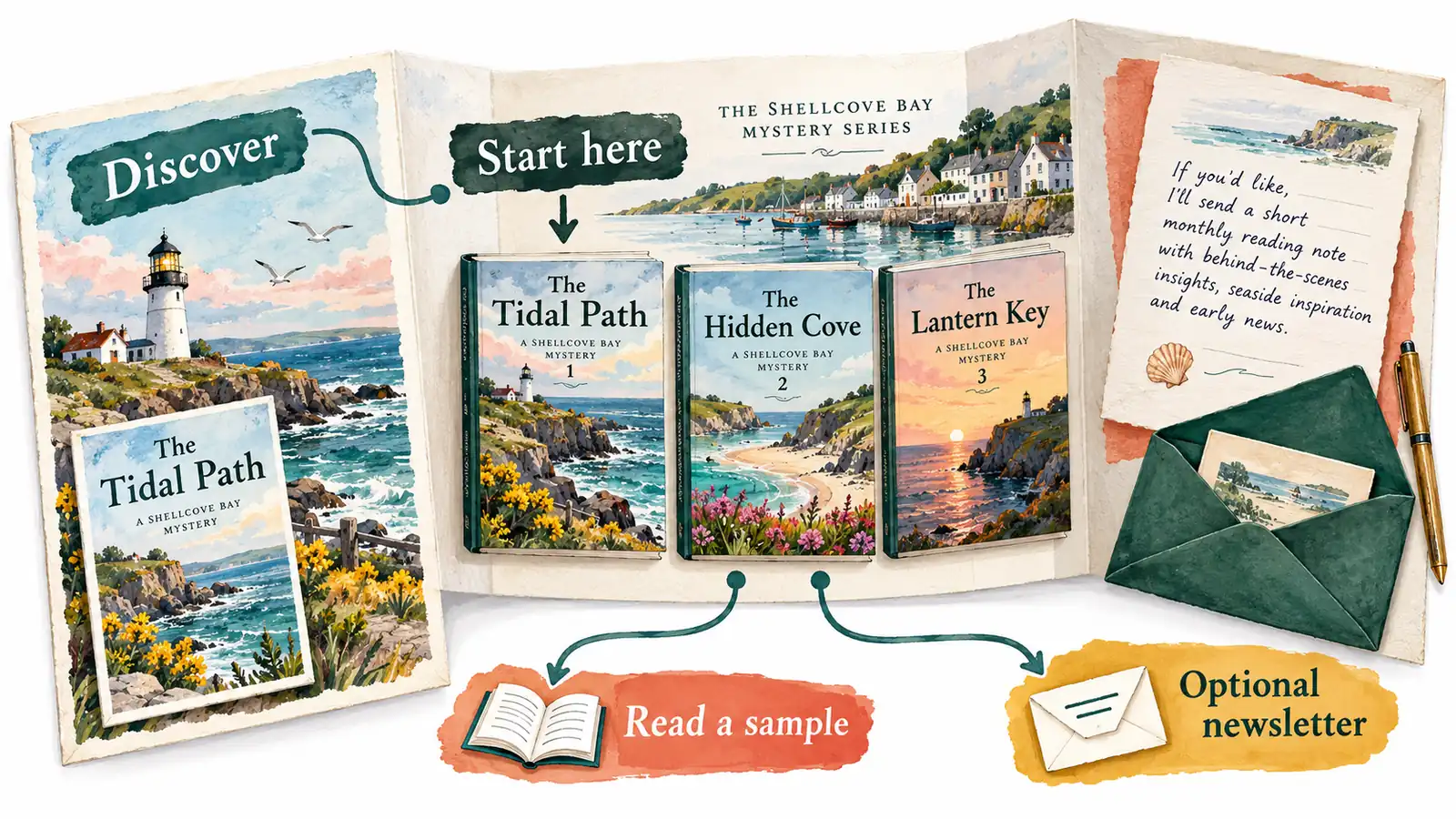
How to build an author platform: start with three connected parts
Create a clear home page for your books, offer a voluntary way to hear from you again, and choose one discovery channel where your intended readers already spend time. Connect those parts with an accurate reader promise. You do not need a large following, a complex website or daily posts on every network.
An author platform is not your follower total. It is a working route from discovery to understanding your books to staying connected. An author with a small relevant audience and a dependable communication process can use that route; a large collection of unrelated followers may not provide it.
| Part | Its job | Evidence it works |
|---|---|---|
| Home base | Explain the books, author and next reading step | A new reader can find the right title and buying link |
| Permission-based email | Let interested readers choose future updates | Signup, welcome and unsubscribe paths work |
| Discovery channel | Reach people who might enjoy the books | Relevant visits, questions or voluntary subscriptions |
Think of the home base and mailing list as assets you administer, not channels immune to rules or service outages. Keep access, domain registration and appropriate records under your control, and respect the reader's choice to leave.
Your site, subscription form and email sending are configured with the external services you choose. Virtalibry presentation polls can help assess book assets; they do not host this author platform or operate the newsletter described here.
Source check: 17 October 2026. The platform structure and 90-day schedule below are practical planning examples. External distribution conditions come from the linked primary source, not an approval of your particular giveaway or campaign.
1. Define the reader promise before choosing channels
Write one sentence describing who your books serve and what they can expect. Use a genre experience for fiction or a supported practical benefit for nonfiction. Make the sentence narrow enough to guide your content and channel decisions.
Fiction example: "I write closed-door mysteries for readers who enjoy amateur sleuths, village secrets and a coastal setting."
Nonfiction example: "I write practical guides for first-time managers who want usable scripts for everyday conversations."
These are positioning examples, not promises of sales. Check that your actual book, cover and sample deliver the stated experience. If readers interpret the cover differently, clarify the presentation before paying to expand the audience.
Handle different genres deliberately
If you publish unrelated genres, give readers a choice rather than sending every announcement to everyone. A single author site can have distinct book sections and subscription preferences. Separate pen names or mailing streams may be useful when the audiences have little overlap, but they also increase maintenance. Start with the clearest structure you can actually support.
2. Build a home base with an obvious reading path
A simple site or landing page is enough initially. Its first job is to tell a reader what you write and where to begin. Do not make them search through a long biography to find the book.
- Use the author or pen name readers will recognize from the books.
- Show the relevant book covers and an accurate description of each title.
- For a series, explain the reading order and link the starting book.
- Provide tested buying links for the editions and marketplaces you promote.
- Offer a clearly described newsletter signup without hiding the book information behind it.
- Include a concise biography, a contact route and an appropriate privacy notice.
Test the page as a stranger
Open it on a phone and ask: what kind of books are these, which should I start with, and what happens if I subscribe? Ask a few suitable readers the same questions. Save repeated misunderstandings and correct them. You can use a Virtalibry presentation poll to compare a cover or description choice, but do not interpret preferences as a forecast of sales.
Test two separate routes. A visitor should be able to find the first book and its sample without subscribing. Someone who chooses a newsletter should reach the correct genre stream and receive the promised welcome material. A purchase link working does not prove the signup works, or the reverse.
Use the cover-poll interpretation example for counts and audience context, and the description claim audit before putting generated copy on the site.
Keep your domain and essential service accounts secure, use multi-factor authentication where available and record renewal responsibilities. A platform that depends on a forgotten login is not a dependable home base.
3. Give readers a specific reason to stay connected
Explain the newsletter before asking for an address. Name the subject, expected frequency and any welcome resource. A reader should not have to guess whether signing up means a monthly note or daily sales messages.
Example signup invitation: "Enjoy coastal mysteries? Join my monthly reading note for new releases and setting details. You will also receive three short welcome emails in the first week, starting with an original extra scene. You can unsubscribe at any time."
A useful resource might be a short original companion scene, a worksheet or a representative puzzle pack. It should attract the same readers as the books. A generic prize can grow the count while providing little evidence of interest in your writing.
Check rights and distribution restrictions before giving away book content, especially if an ebook is enrolled in an exclusive program. The KDP Select requirements are one example of terms to review. Do not assume that every digital giveaway is permitted.
For an enrolled Kindle ebook, do not offer the full ebook from your own signup page simply because it is free. Check the current enrollment dates and sample allowance first. A separately written companion resource still needs its own rights check; calling a file a bonus does not establish that it is outside the enrolled book.
Use the separate author email-list guide for the form, confirmation flow and welcome sequence. A follow on a marketplace or social site is not automatically permission to add someone to your own newsletter.
4. Choose one primary discovery channel
Pick a channel because the intended readers use it and you can contribute something relevant. Do not choose it only because it is popular with other authors. Define the route from that channel to a book, sample or optional signup.
| Channel | A useful contribution | Main constraint |
|---|---|---|
| Reader community | Relevant discussion or a permitted book introduction | Promotion rules and trust must be respected |
| Partner newsletter or interview | A sample, conversation or practical contribution | Acceptance and audience fit are uncertain |
| Searchable author content | A specific answer related to the books' topic | Useful content takes work and search traffic is not guaranteed |
| Selected social channel | A scene, demonstration or reading recommendation | Reach is variable and production can consume writing time |
Write a channel hypothesis
For a beginner puzzle series, a clear interior demonstration may be more informative than a broad motivational post. For practical nonfiction, a useful discussion with a relevant host may explain the book better than an unrelated giveaway. These are hypotheses to test, not universal channel rankings.
Record who you hope to reach, what you will publish and where an interested reader can go next. Do not send unsolicited messages to community members or treat participation as permission to collect their addresses.
5. Build a small content system around reader interests
Choose a few repeatable themes that connect to the books. Each piece should do one job: introduce the experience, answer a buying question or give an interested reader a reason to return.
- Fiction: setting research, a character question, a brief original scene or a clearly identified reading recommendation.
- Practical nonfiction: a representative exercise, an explanation of a common mistake or an example of the method in use.
- Activity books: a readable sample, a difficulty comparison or a demonstration of how the interior works.
Use one clear next step
A sample post can lead to the book page. A companion-resource post can lead to an optional signup. A newsletter can invite a reply to one question. Asking for a purchase, follow, share, subscription and review in the same message makes the next step less clear.
Reuse an idea across formats when it remains useful, but adapt it to the venue. A paragraph suitable for an author email may need a demonstration in a visual channel. Avoid repeating a buying link in communities that do not allow promotion.
6. Use a 90-day plan with visible outputs
| Period | Work | Finish with |
|---|---|---|
| Days 1-14 | Define the reader; prepare the home page and book links | A tested page with a clear reading path |
| Days 15-30 | Set up an optional signup and welcome messages | A completed subscription and unsubscribe test |
| Days 31-60 | Try one discovery channel with relevant content | A dated activity log and observable reader response |
| Days 61-90 | Review effort, response and recurring questions | A decision to continue, simplify or change the channel |
This schedule is a working example, not a follower or income target. If the manuscript needs attention, reduce the platform workload rather than delaying the book indefinitely. A small system that runs consistently is more useful than an elaborate setup you abandon.
A bounded weekly routine: set aside 30 minutes for link and subscription checks, 45 minutes for one useful channel contribution and 45 minutes for reader replies or the next newsletter draft. That is two hours, not a required cadence or a growth forecast. Reduce the scope if it displaces the writing schedule.
7. Measure reader continuity, not only audience size
Track relevant visits where measurable, completed subscriptions, meaningful replies and movement toward the book. Note the source and date of a campaign. Do not label every social follower as a future buyer or calculate a sales forecast from an arbitrary conversion percentage.
Define a completed subscription using the actual form process. If confirmation is required, pending signups are not active subscribers. Count preferences separately from the total contact count, and do not treat an email provider's delivery status as proof of inbox placement or reading.
A small monthly scorecard
- Which activity brought people who understood the books' genre or use case?
- Did the book, signup and resource links work?
- Which question or misunderstanding appeared repeatedly?
- How much time and money did the activity require?
- What should continue, change or stop next month?
Separate total subscribers from active permission to receive a particular stream. Respect unsubscribes and keep export, deletion and suppression processes aligned with your provider and applicable rules. You are maintaining reader relationships, not collecting a permanent entitlement to contact people.
8. Make platform maintenance part of publishing
Assign a recurring time block for checking links, answering useful questions and preparing the next message. Keep a current asset folder, protect account access and maintain appropriate backups. Review whether the promised email frequency still fits your actual output.
If the platform is growing but the book is not ready, do not promise a release date you cannot meet. If the book is ready but exposure is limited, use a bounded first-sales experiment or assess a third-party book newsletter placement. Paid exposure can complement the platform; it does not replace the reader's separate choice to subscribe.
Connect the ongoing tasks to your marketing checklist. Your next step is to finish one working reader path: discovery, a clear book introduction and an optional way to hear from you again.
Explore the book marketing guides to connect this task with launch planning, audience building and promotion.
Frequently asked questions
What is the minimum author platform I need?
Start with a clear home page for your books, a voluntary way to hear from you again and one relevant discovery channel. Connect them with an accurate reader promise and test the path on a phone before adding more tools.
Can I build a platform before my first book is published?
Yes. Explain what you write, offer useful content you can legitimately share and invite interested readers to hear from you. Avoid promising an uncertain release date or allowing platform work to replace finishing the book.
Do I have to use every social network?
No. Choose one channel based on reader fit, your ability to contribute and the time required. A selected channel with a clear next step is easier to maintain and evaluate than several neglected accounts.
Should I keep different genres on the same platform?
That depends on audience overlap and maintenance capacity. A single site can have separate book sections and email preferences. Distinct pen names or streams may help when interests differ substantially, but they require additional work.
Does an author platform guarantee book sales?
No. It creates a route for discovery and continued contact, not a sales guarantee. Evaluate whether suitable readers understand the offer, choose to stay connected and take relevant next steps rather than forecasting purchases from follower totals.
What should I review after the first 90 days?
Check the reader journey, useful response, subscription flow, recurring questions and time spent. Decide which channel to continue, simplify or replace. Keep the review tied to completed work and observed behavior rather than a universal follower target.