

Email List for Authors: Build a Clear Reader Subscription
Create a voluntary signup, deliver the promised welcome resource and send messages that fit the reader's expectations. Test the full journey before bringing more people to the form.
This guide includes service-selection checks, example signup copy, three complete welcome-message bodies and a practical delivery and measurement routine.
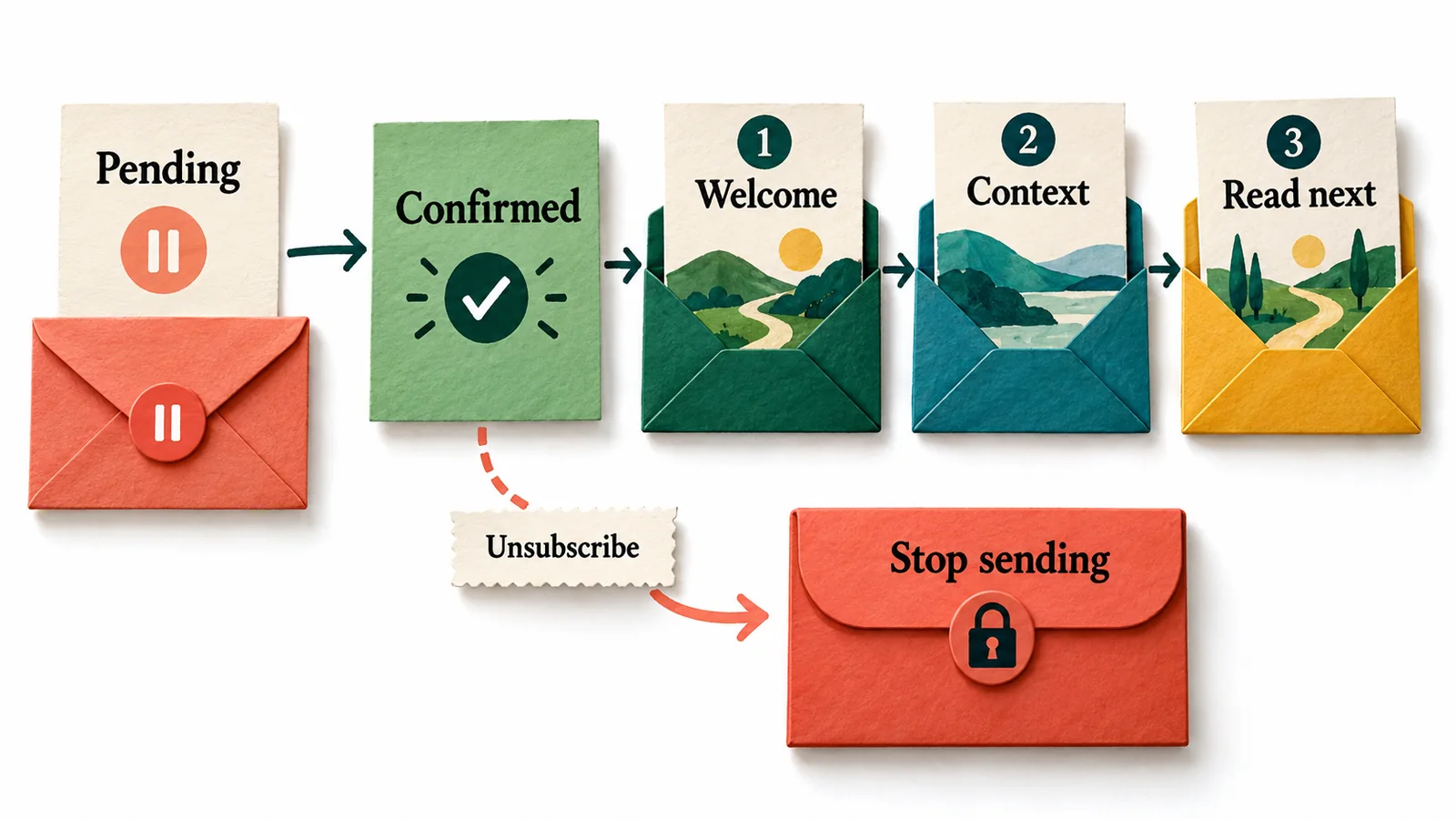
Build an author email list around a clear subscription
Choose an email service, create a signup page that explains the messages, and prepare a short welcome sequence. Invite suitable readers to join voluntarily. Test the entire path, including unsubscribe, before promoting it.
This guide covers your own subscriber list. Paying for a book placement in another publisher's newsletter is a different activity; use the book promotion email-list guide for that. A recipient of a partner promotion is not automatically your subscriber.
The email service, forms and automation in this guide are external tools you configure, not a newsletter builder or author-mailing service inside Virtalibry. Choose a provider that supports the required workflow before collecting addresses.
Source check: 17 October 2026. Provider settings, sending requirements and privacy guidance are linked where they apply. The example sequence is not a complete legal footer or a guarantee of delivery.
| Part | Purpose | Check |
|---|---|---|
| Email service | Manage subscriptions, sending and suppression | Supports your form, automation and unsubscribe needs |
| Signup page | Explain the author, topics and frequency | The reader knows what they are choosing |
| Welcome messages | Deliver the resource and set expectations | Correct timing and links for a new signup |
| Working opt-out | Stop unwanted future marketing | Unsubscribed addresses are not re-added accidentally |
1. Choose a service for the workflow, not just a free allowance
Compare the features you will actually use: hosted or embedded forms, confirmation, a short automation, clear subscription preferences, exports and suppression handling. Check current limits and the cost at your expected list size rather than selecting from an old pricing comparison.
- Confirm that the service permits your intended content and acquisition methods.
- Check how contacts, unsubscribes and duplicate addresses affect billing.
- Verify whether automation, domain authentication and export are available on the chosen plan.
- Check what happens to active automations and suppression records if you migrate.
- Use a recognizable sender name and a reply address you monitor.
You do not need custom mailing infrastructure for a small author newsletter. A suitable service can handle much of the sending workflow, but you remain responsible for accurate content, appropriate permission and the configuration it asks you to complete.
2. Give the reader a specific invitation
State what you write, what the newsletter contains and approximately how often it arrives. If a resource is included, describe it accurately. Request only the information needed for the workflow; a first name can be optional when personalization is not essential.
Example form copy: "Join my monthly coastal-mystery newsletter for new releases and setting notes, plus three short welcome emails during your first week. The first includes an original extra scene. Enter your email to subscribe. You can unsubscribe at any time."
Use that copy only if it matches your actual content and schedule. Put an appropriate privacy notice near the form. Avoid a preselected marketing choice or a vague "get updates" label that conceals frequent promotions.
Choose a resource that attracts the right readers
An original companion scene can suit fiction. A short worksheet can suit practical nonfiction. A readable activity sample can suit puzzle books. Check that you have the rights to distribute it and that any publishing exclusivity terms allow the intended use.
Do not make a newsletter resource conditional on leaving a public review or purchasing a book. Keep resource delivery and marketing permission clear; collecting an address for a different purpose does not by itself establish newsletter permission.
3. Record the subscription and test confirmation
Use a permission-first process and keep the signup source, date and wording needed to understand what the reader agreed to. Requirements vary by jurisdiction and context; this workflow is not legal clearance. For example, the UK regulator's guidance on marketing lists explains why third-party permission needs scrutiny.
Understand double opt-in
Double opt-in adds a confirmation message after signup; the reader confirms before becoming an active subscriber. It can help verify the address and the intended subscription, but it is not a universal guarantee of compliance or inbox placement. Check how your provider implements it; Mailchimp's explanation illustrates the process.
Test the actual collection route, not only an account setting. Mailchimp documents its double-opt-in setting for its signup forms; integrations and API-based collection need their own verification. An import or another form must not silently turn a pending or unsubscribed contact into an active subscriber.
Record the form version or invitation wording, signup source, time and selected stream using the minimum information your process needs. Consent for a mystery newsletter is not permission for an unrelated pen name. The ICO's UK marketing-list guidance covers permission records and opt-outs; it is currently marked as under review. Check the rules that apply to your audience rather than treating this example as global legal advice.
- Submit the form using a fresh test address.
- Check the confirmation page and message, if enabled.
- If confirmation is required, leave one signup pending and verify that it does not enter the welcome marketing sequence.
- Verify resource access, the sender identity and the stored signup source.
- Unsubscribe after the first welcome email and verify that messages two and three, and queued broadcasts for that subscription, stop.
4. Start with three useful welcome emails
The schedule below is an example, not a deliverability formula. Begin only when the subscription is active under your chosen process. Adjust the timing to what the form promised and avoid overlapping a welcome sequence with several launch broadcasts.
| Message | Example timing | One main job |
|---|---|---|
| Welcome and delivery | After the subscription becomes active | Deliver the promised resource and explain future messages |
| Useful reading context | A few days later | Share something relevant to the reader's interest |
| Next reading invitation | Later in the first week | Introduce a suitable book or reading starting point |
Email 1: deliver the promise
Subject: Your coastal-mystery extra scene
Thanks for joining my monthly reading note. Here is the original extra scene I promised: [resource link].
I write closed-door mysteries set by the coast. Two more short welcome emails follow this week; after that, expect release news and setting notes about once a month. If this is not what you expected, you can unsubscribe below.
[Author name]
Email 2: give useful context
Subject: The detail that inspired the harbor setting
The village in my stories began with a question: what would a retired librarian notice that everyone else missed? That question shaped the harbor festival and the first mystery.
If you enjoyed the extra scene, what drew you in: the setting, the characters or the puzzle? You can reply with a word or two.
[Author name]
Email 3: offer the next reading step
Subject: Where to start with the coastal mysteries
If this sounds like your kind of reading, the first book introduces the librarian and the village. You can read its description and sample here: [book link].
It is a closed-door mystery with an amateur sleuth and a small-town setting. There is no need to buy to remain on the newsletter.
[Author name]
Replace the example story details with facts about your writing. Every message also needs the sender information and unsubscribe facilities required by your provider and applicable rules. The examples above show the body, not a complete compliance footer.
Check the book details in these messages with the description claim audit. Do not promise a scene, worksheet, credential or result merely because generated copy supplied one.
5. Plan messages between releases
Choose a cadence you can maintain. An author who promises a monthly note does not need to invent daily content. Share a useful sample, an honest progress update, a reading-order explanation or a question that is relevant to the books.
- Give each email one primary reason to exist and one main next step.
- Use a subject that accurately describes the contents.
- Separate substantially different genres or reader preferences when appropriate.
- Remove expired price offers and do not manufacture a deadline.
- Check that new subscribers are not receiving duplicate automated and broadcast messages.
Use the launch strategy guide when planning a release announcement. A newsletter is not an obligation to send whenever you need a sale; the subscription promise still governs the relationship.
6. Check sending configuration and the complete opt-out path
Follow your service's instructions for sender-domain authentication. Review SPF, DKIM and DMARC configuration rather than assuming a paid account handles every step automatically. Gmail distinguishes general and bulk-sender requirements; its current sender guidelines explain authentication and unsubscribe expectations. A visible body link and the provider's one-click unsubscribe headers are different parts of the workflow.
| Sender group | Authentication minimum | Check separately |
|---|---|---|
| All senders | SPF or DKIM | Other sending requirements and the actual message result |
| Bulk senders under Gmail's current definition | SPF, DKIM and DMARC, with alignment | One-click unsubscribe for marketing/subscribed mail and a visible body opt-out |
Check Google's current volume definition. These are Gmail-specific minimums, not every provider's rules. Inspect a test message's authentication results; saved DNS settings do not prove the message passed.
For this check, Google's bulk-sender section covers senders exceeding 5,000 messages a day to personal Gmail accounts. Ask your provider to verify the applicable classification and headers. A body unsubscribe link alone does not implement one-click unsubscribe.
Test the message on a phone: can the reader understand it without images, open the resource and find the opt-out? Check that replies reach the monitored address. Do not describe authentication as a guarantee against spam filtering.
When something fails
- If the confirmation does not arrive, inspect provider logs, the address and sender setup before resending repeatedly.
- If resource access fails, fix permissions or the destination before inviting more signups.
- If an unsubscribe fails, stop the affected marketing flow and correct it.
- If you migrate providers, preserve appropriate suppression state and do not turn old unsubscribes into new subscribers.
7. Measure behavior without treating opens as proof
Track subscription completions, delivery problems, useful replies, clicks and unsubscribes. Keep definitions consistent. Privacy features can limit the interpretation of open tracking; Apple's Mail privacy explanation is one reason not to equate an open with a person reading the message. Automated security checks can also affect click data.
Illustrative calculation: 12 unique recorded clickers from 300 delivered messages is a 4% recorded click rate. It is not a 4% purchase rate, and it does not prove every recorded click was human. Use provider definitions and actual order evidence where available.
Keep the denominator visible: sent, delivered and active subscribers are different counts. A delivered status is not a read receipt. Do not compare one provider's clicks per delivered message with another report's clicks per sent message as if they were the same rate.
Maintain the list deliberately
Review complaints, hard bounces and stale permissions with your provider's guidance. Do not remove or reactivate people based on open tracking alone. Retain only the records appropriate to the stated purpose and applicable rules, and protect exports rather than leaving address files in shared folders.
Keep the minimum appropriate suppression record separate from the active audience so an old export cannot re-add someone who opted out. Test that protection during a migration. Do not send an unsolicited reactivation campaign to suppressed addresses simply because you moved services.
8. Finish one working reader journey
Before promoting the signup page, complete a fresh-address test from invitation to resource delivery to unsubscribe. Then invite a small relevant audience and review the response before adding more automation.
Use two test subscriptions: leave one unconfirmed when confirmation is required; confirm the other, receive email one, then unsubscribe. The expected result is no welcome marketing for the pending address and no emails two or three for the opted-out address. Check provider queues and logs, not only the subscriber badge on the screen.
Connect the list to your author platform and maintain it through the marketing checklist. If you need outside reach, evaluate a third-party newsletter placement without confusing that audience with your own subscribers.
Explore the book marketing guides to connect this task with launch planning, audience building and promotion.
Frequently asked questions
How do I start an author email list from zero?
Choose a suitable email service, write a specific subscription invitation and prepare a short welcome sequence. Test signup, confirmation when enabled, resource delivery and unsubscribe. Then invite a small relevant audience to join voluntarily.
What should I offer new subscribers?
Offer something connected to the books, such as an original companion scene, a worksheet or a readable sample. Describe it accurately, verify distribution rights and any exclusivity terms, and make clear what future messages the subscription includes.
Do I need double opt-in?
It can help verify the address and intended subscription; requirements depend on context and applicable rules. Test the actual form or integration, not just the provider's setting, and keep appropriate permission records. Confirmation does not guarantee compliance or inbox placement.
How many emails should a welcome sequence contain?
Three can be a manageable starting point: deliver the resource, share reading context and offer a suitable next step. Disclose these introductory messages alongside the regular newsletter frequency. If someone opts out during the sequence, stop future marketing for that subscription.
Can I add people who bought my book or followed me elsewhere?
Do not assume that a purchase, follow or unrelated interaction establishes permission for your newsletter. Use a clear subscription process and check the rules applicable to your audience and provider.
Which email statistics matter most?
Review subscription completions, delivery problems, useful replies, clicks and unsubscribes using consistent definitions. Opens do not prove reading, and clicks do not prove purchases. Consider privacy features, automated traffic and attribution limits before drawing conclusions.