

Book Promotion Email Lists: Evaluate the Placement
Reach a suitable reader audience through a clearly defined newsletter feature. Check what the publisher will deliver, whether the offer fits and what the placement would need to earn before you pay.
Compare your own mailing list with third-party exposure, inspect real provider examples and use written terms, simple economics and delivery evidence to make the decision.
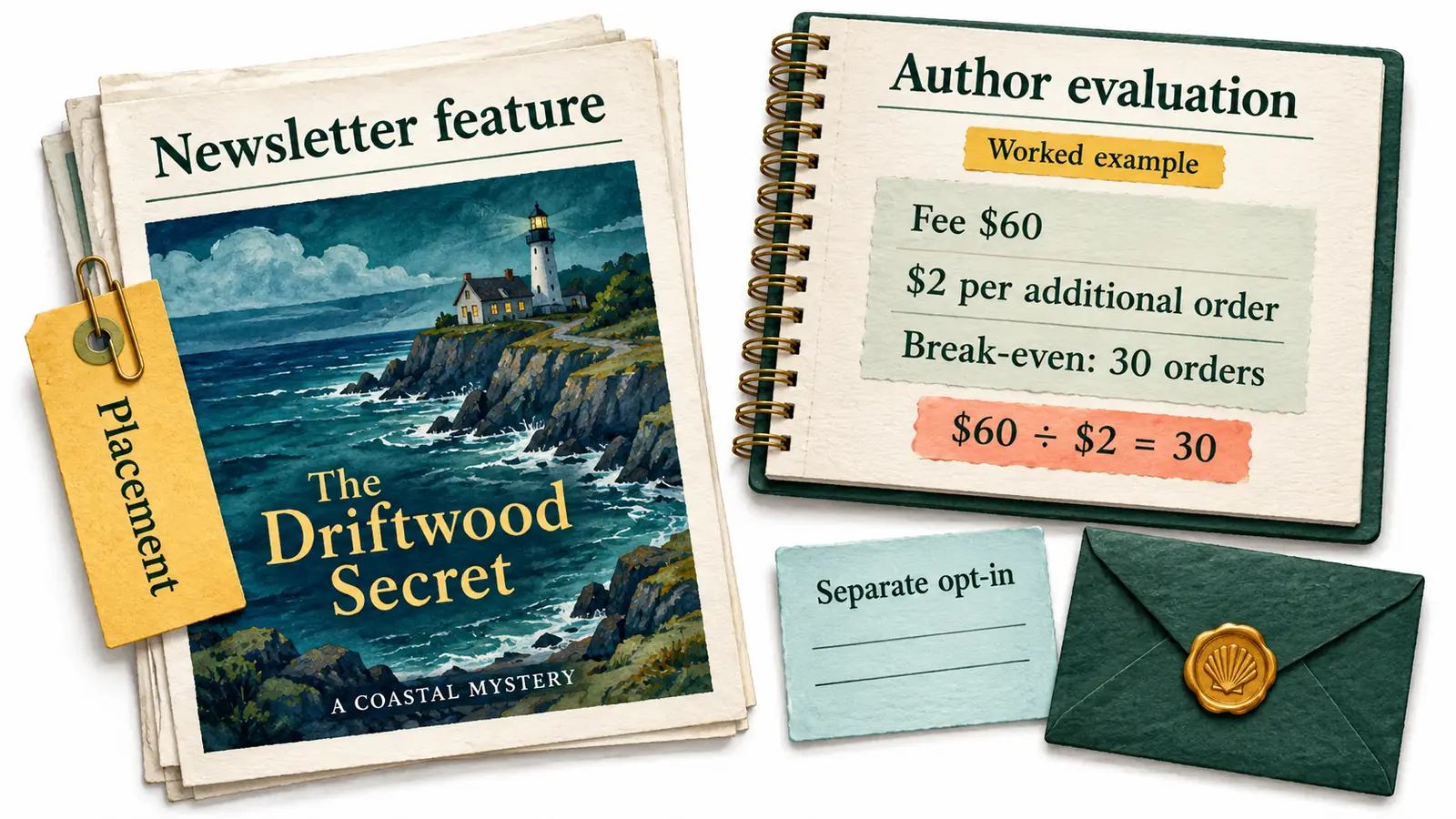
Book promotion email lists: buy a placement, not a contact database
A third-party book newsletter can introduce your book to its existing reader audience. You pay for or arrange a defined feature; the publisher sends it under its own subscription relationship. That is different from acquiring subscribers for your author newsletter.
Do not buy or scrape addresses and assume they come with permission to receive your marketing. If you want your own ongoing communication channel, use the author email-list guide. A reader who sees, clicks or buys from a promotion has not automatically joined your list.
These placements are booked with the external publisher under its own terms. Virtalibry does not book, send or guarantee the third-party newsletter features described here.
| Model | What you receive | What it does not give you |
|---|---|---|
| Your author newsletter | A voluntary subscription to your stated messages | Unlimited permission to send unrelated content |
| Third-party book feature | Specified exposure in a publisher's newsletter or associated placements | Ownership of the publisher's subscribers |
| Purchased address file | Contact data with permission and provenance questions | An automatic right to send book promotions |
For the UK, the ICO's marketing-list guidance explains the scrutiny needed for bought-in data. Other jurisdictions have their own rules. This guide evaluates newsletter placements, not a shortcut around consent requirements.
The ICO marks that guidance as under review following legislative changes. Recheck its update notice and the rules that apply to the actual recipients before collecting or importing data; a publisher's placement invoice is not evidence of consent to your separate newsletter.
1. Match the audience before comparing prices
Define the genre, format, buying situation and marketplace. A discounted ebook offer for established genre readers is not the same product as a print workbook or a full-price practical guide. A large subscriber total cannot resolve a mismatch.
- Does the publisher reach readers of the actual genre or topic?
- Does the placement support your edition and target marketplace?
- Does the audience expect free, discounted, new-release or full-price books?
- Does the book meet current content, length, quality and price requirements?
- Is the buying page accurate and available before you send new readers to it?
Choose the campaign goal
For a discounted paid ebook, the goal may be attributable royalties or a limited test of paid interest. For a free book, it may be relevant discovery. Keep free claims, paid orders, later series activity and voluntary subscriptions separate rather than counting all of them as sales.
A placement can be worth investigating for a new audience without being profitable immediately. State that objective in advance and cap the cost of the experiment. Do not relabel a loss as "brand building" only after seeing disappointing results.
2. Use real service examples without assuming a universal winner
The examples below illustrate different offers, not a ranked shortlist or a prediction of results. Service details were checked on 17 October 2026. Verify the current product, eligibility, availability and quoted price on the provider's site before submitting.
| Service | Model to investigate | Check before applying |
|---|---|---|
| BookBub Featured Deals | Editorially selected ebook offers: free or discounted by at least 50% | Price history, length, retailer/region and other requirements; a qualifying submission can still be declined |
| Freebooksy / Written Word Media | Features for free ebooks | The book must have the required free offer; the placement itself is not necessarily free |
| Bargain Booksy / Written Word Media | The overview currently advertises ebooks priced $0.99 to $5 | Genre, the actual offer, availability and checkout quote; this is a book-price range, not a placement fee |
| NewInBooks / Written Word Media | New-release promotion products and launch stacks | Included brands and deliverables; a bundle is not equivalent to one isolated email feature |
| A relevant independent newsletter | A placement or partner feature negotiated with the publisher | Actual reader fit, permission to promote, delivery evidence and written terms |
BookBub's Featured Deals requirements are a useful example of why an application is not a booking confirmation. Avoid copying another author's historical fee or sales result into your forecast. The offer you can actually obtain may differ.
For Written Word Media, the email-promotion overview also states an Amazon.com availability requirement. Check the specific brand and booking flow for the edition you intend to promote. Do not assume the word “free” describes the service fee or that every product accepts the same formats.
The same overview currently allows a full refund when cancellation is made three business days before the scheduled promotion; it excludes refunds within that window or when the title's price is wrong on the promotion morning. Confirm the deadline and terms for your actual booking. A requested date is not an accepted placement.
Read a sample issue
Look at how books appear to readers: competing titles, space for the description, genre grouping and the destination of the click. Ask whether the quoted product is an email feature, website listing, ad or bundle. These are not automatically equivalent deliverables.
3. Get the essential answers in writing
- Which exact newsletter, genre segment and region will carry the book?
- What format and price must the book have, and for what period?
- What is the total fee, including any relevant extras?
- Is the date confirmed or only requested?
- Who writes the blurb and approves the buying link?
- What proof of delivery and reporting will be available?
- What happens if the book price or availability is wrong?
- What are the cancellation, refund and rescheduling conditions?
Example inquiry: "I am considering a feature for a closed-door coastal mystery in Kindle format. The intended audience is US mystery readers. Can you confirm the exact placement, price requirements, available dates, total cost and reporting supplied? Please also explain what happens if the public price has not updated by the feature date."
Use the provider's actual submission process rather than bypassing it with a generic pitch. If essential answers remain unclear, do not pay merely because the site advertises a large mailing list.
4. Calculate a break-even reference using the offer royalty
Use the royalty at the promotional price, not the regular retail price. A deeply discounted book can generate many orders without recovering a placement fee. Use an estimate from your actual edition setup and state what costs the calculation excludes.
The $2 contribution in the worked example below is an assumed input, not a royalty quote for a $0.99 ebook. Recalculate it for the edition, territory and actual offer. Use the royalty calculator for a scoped estimate and the publishing ROI example when including costs beyond the placement fee.
| Example | Calculation | Interpretation |
|---|---|---|
| Paid-order test | $60 fee / $2 royalty contribution per additional order = 30 orders | 30 additional paid orders would cover the placement fee alone |
| Observed response | 12 recorded orders provisionally attributed to the feature x $2 royalty = $24 | Even if all 12 were additional, the $60 fee leaves a $36 shortfall before other costs |
| Free-book feature | No paid-order royalty on the free claims | Evaluate a stated discovery goal; do not report the claims as paid revenue |
Do not assume future series revenue
Attribution is not proof of additional demand caused by the feature. A timing match or tracked click does not establish what the reader would have done without it. If the paid-order royalty contribution is zero or negative, dividing the fee by it gives no useful finite paid-order break-even target; free claims need a separate discovery goal.
Later reading may matter, but include it only when you have an appropriate observation method and enough evidence. Do not assign an invented lifetime value to every free download. If the goal is learning, define the maximum fee you are comfortable spending to learn.
For a first test, keep enough budget to revise an observed problem. Booking several untested promotions at once can increase exposure while making it harder to determine which placement contributed.
5. Prepare the submission and protect the schedule
Make a clean submission package
- Use the exact title, author name, edition identifier and buying link.
- Provide the current cover and a concise, accurate genre-specific description.
- Specify the current and proposed price, region and real offer dates.
- Check sample readability, book availability and link behavior on a phone.
- Record requested dates separately from confirmed ones.
When an offer depends on a retailer price change, leave a buffer and verify it publicly before the feature. A submitted price change is not proof that readers see it. Consult KDP's timelines for Amazon-related updates.
Use the description claim audit before submitting a generated blurb. Check the promised contents and format against the actual book rather than treating a fluent draft as verified copy.
Use a go/no-go check
Before the placement, confirm the book, marketplace, edition, price and destination. If something is wrong, follow the publisher's agreed escalation or rescheduling process. Do not silently leave inaccurate offer wording in circulation.
Save the booking confirmation and final materials. Note other campaigns running at the same time. For a coordinated release, connect the placement to your launch plan rather than treating the provider's send date as the whole strategy.
6. Review delivery and outcomes separately
First verify that the purchased activity happened. Then assess reader response. A delivered placement and a profitable placement are different conclusions, and the provider's terms determine the remedy for a delivery failure.
| Record | Where it comes from | Limitation |
|---|---|---|
| Date and feature evidence | Publisher confirmation or issue copy | Does not prove anyone purchased |
| Available clicks | Provider report or permitted tracking | Definitions and automated traffic can affect counts |
| Paid orders and royalties | Retailer reports and campaign notes | Timing and overlapping activity limit attribution |
| Voluntary subscriptions | Your own signup process | Only counts people who separately chose your newsletter |
Allow for report delays before judging the observation period. Do not assign every order after the send to that feature, add estimated sales-rank orders to actual orders or treat subscriber count as the number of people who saw the book.
7. Decide whether to repeat, revise or stop
Repeat when the audience fit, evidence and economics justify another bounded test. Revise when there is a specific issue, such as a wrong-marketplace destination or a description that attracted the wrong readers. Stop when repeated activity does not serve the stated goal or remains impossible to verify.
Build your own relationship separately
A promoted book can introduce your author work, and an interested reader may later choose your newsletter. Keep that invitation clear and voluntary; do not ask the promotion publisher to hand over its recipients or auto-import them into your list.
8. Put placement tests inside a wider platform
Use a third-party feature for a defined audience opportunity, not as the only way readers can find you. Maintain a clear author home base and review campaign tasks through the marketing checklist. Your next step is a verified audience match and written placement terms, not the largest available mailing-list number.
Explore the book marketing guides to connect this task with launch planning, audience building and promotion.
Frequently asked questions
Are book promotion email lists the same as my author mailing list?
No. Your list consists of people who chose your stated subscription. A third-party placement introduces the book to another publisher's audience. Seeing or clicking that promotion does not automatically subscribe someone to your newsletter.
Should I buy a list of reader email addresses?
This guide recommends evaluating newsletter placements rather than acquiring contact databases. An address file does not establish permission for your marketing. Check provenance, applicable rules and provider policies rather than assuming purchased data is usable.
Which newsletter promotion service is best for my book?
There is no universal winner. Compare genre, edition, marketplace, expected offer type, eligibility, quoted fee and reporting. Inspect the current product and written terms; a large audience number or another author's result is not enough.
How do I calculate the break-even point for a paid placement?
Divide the placement fee by positive royalty contribution per additional paid order at the offer price. This covers the fee alone; attribution does not prove additional demand. Zero or negative contribution gives no useful finite paid-order target, and free claims generate no paid-order royalty.
Does meeting a provider's requirements guarantee acceptance?
Not always. Some products use editorial selection or have limited availability. Treat a submitted application and requested date as unconfirmed until the publisher provides an actual booking confirmation.
How should I judge the campaign after the email is sent?
Verify delivery separately from outcome. Record available clicks, retailer orders, royalties and other concurrent activity, allowing for reporting delay. Repeat only when evidence and the stated goal support another bounded test.