

How to Promote a Book on Amazon
Prepare the public listing, choose a promotion method that fits the book and set a clear limit on time or money. Match each tool to a specific problem rather than expecting one tactic to do everything.
Compare listing improvements, author assets, advertising, KDP Select price tools and outside reader outreach, with practical checks and royalty-based examples.
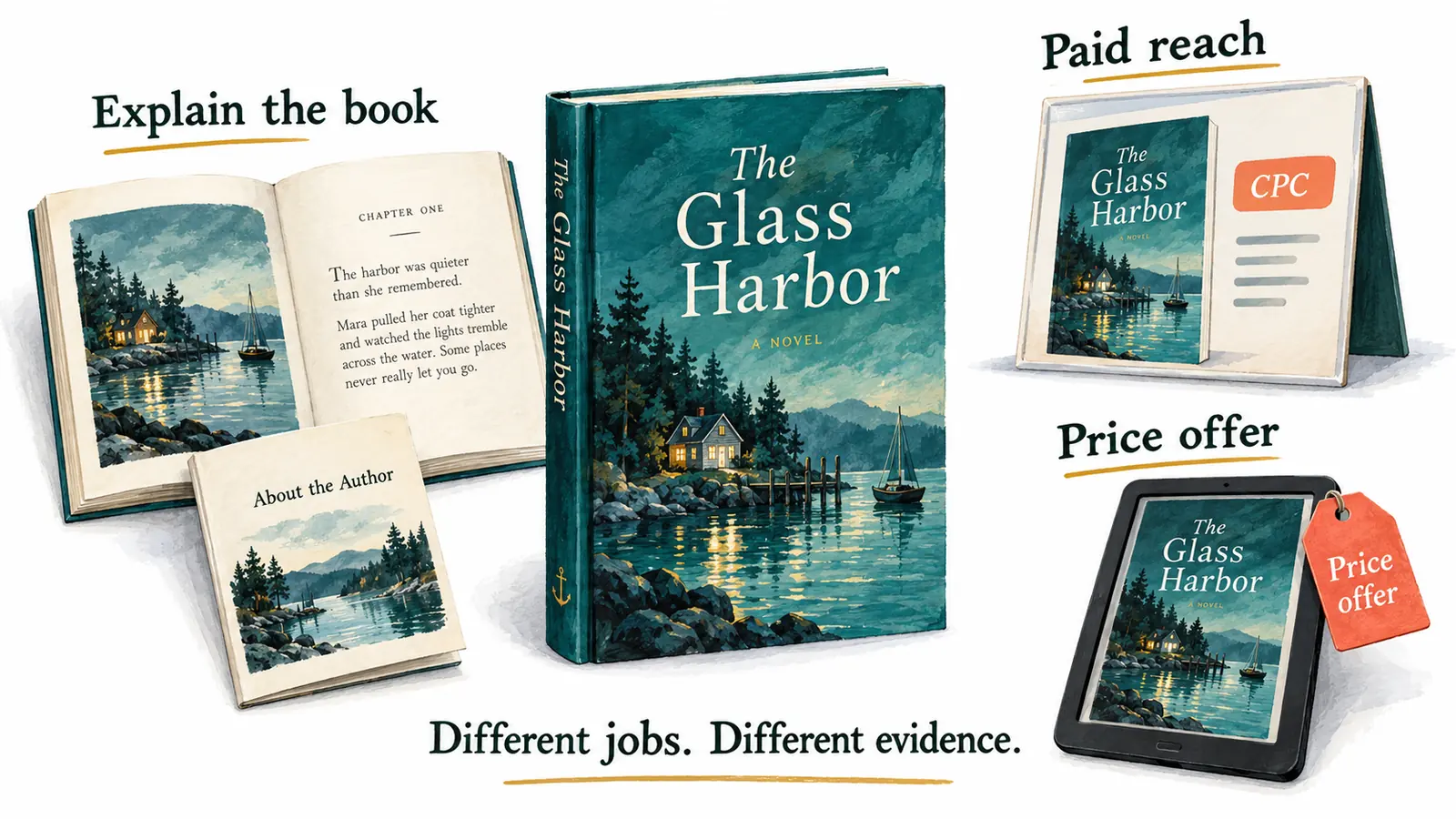
How to promote a book on Amazon: choose the tool for the job
First make the book's public page accurate and convincing. Then choose between a relevant external audience, a limited advertising test or an eligible price promotion. Track the outcome that matters for that activity and compare its cost with the royalty it can reasonably produce.
Metadata, A+ Content, ads and price promotions are not interchangeable. Better presentation helps readers understand the offer; advertising purchases an opportunity to be seen; a price offer changes the buying proposition. None guarantees organic ranking, reviews or profitable sales.
Source check: 17 October 2026. The official links below describe the relevant tool and its conditions. Examples of click economics and advertising cost of sales are hypothetical calculations, not account results or recommended bids.
| Method | Primary job | Important limitation |
|---|---|---|
| Accurate keywords and categories | Describe the book for relevant discovery | Metadata does not guarantee search placement |
| Author Central and A+ Content | Explain the author and book more clearly | Presentation is not a standalone traffic source |
| Sponsored Products | Test paid visibility for eligible books | Clicks cost money even without orders |
| Free Book Promotion | Offer an eligible Kindle ebook free temporarily | Free claims are not paid sales |
| Kindle Countdown Deal | Run an eligible time-limited ebook discount | Enrollment, marketplace, timing and price rules apply |
| Relevant outside audience | Bring interested readers to the listing | Venue fit, permission and attribution still matter |
Start with the official KDP promotion overview. Tool availability can vary by account, title and marketplace; check your current setup before booking a campaign around a feature.
1. Prepare the public listing before paying for exposure
- Open the correct marketplace and edition, and verify that readers can buy it.
- Check that the cover identifies the genre or use case at thumbnail size.
- Make the description opening specific: a story hook, audience or practical result supported by the book.
- Check a representative sample for quality and consistency with the promise.
- Review the price against the format, audience and actual per-order royalty.
- Verify format and series links before directing readers to them.
Use metadata to describe, not mislead
Choose keywords a suitable reader might use and categories that genuinely describe the contents. Do not treat a low-competition category as useful if its readers want a different kind of book. Avoid keyword stuffing and misleading promotional claims; follow KDP's keyword guidance.
For example, a beginner large-print Sudoku book should communicate difficulty and legibility, not merely "puzzles." Metadata can support that distinction, but the cover and sample must deliver the same message. Correcting one field will not fix a contradictory offer.
Check changes where customers see them
Save a dated before-and-after note for a substantial listing change. Public updates, samples and edition linking may take different amounts of time. Check the publishing timelines before assuming a pending update has failed or sending a campaign to an unfinished page.
2. Use Author Central and A+ Content to answer buying questions
In Author Central, check the books associated with your profile and keep the available author information accurate. In A+ Content, use relevant images and concise explanations to show what a reader will receive. These assets should reduce uncertainty, not repeat the same slogan in several places.
- For a workbook, show a readable representative interior and explain how it is used.
- For a cookbook, show the actual layout and the kind of recipes included without inventing health outcomes.
- For a series, clarify the reading order and how the books relate.
- Check mobile readability, image rights, assigned editions and intended language.
- Follow the current content rules instead of copying another listing's claims or review quotations.
Consult KDP's A+ Content instructions. A+ Content is an explanation layer, not evidence that the book will convert better or rank higher. If it adds no useful information, improving the core description may be a better first task.
Check the assigned ASINs, marketplace and language after publication. A draft copied to another marketplace is not proof that its content is live there. Do not paste customer-review quotations into A+ Content; editorial endorsements follow separate restrictions in the linked guidance.
Before publishing that description, audit its claims against the manuscript. Generated copy must not invent credentials, bonuses or outcomes that the book does not deliver.
3. Run Sponsored Products as a bounded experiment
Sponsored Products uses cost-per-click advertising for eligible books. Review the official author guide and your title's eligibility before building a campaign. Do not assume every format or marketplace supports the same options.
Write the hypothesis before opening the campaign
Example: "Readers searching for beginner large-print Sudoku may be interested in this edition. I will test a small group of genuinely relevant targets, with an affordable spend limit and a review date, after verifying the sample and buying link."
- Choose the eligible edition and marketplace. Check the destination rather than relying on the campaign name.
- Select a manageable targeting approach. Keep the initial test narrow enough to understand the queries or products attracting clicks.
- Set bids, budget and an end date. Inspect bidding and placement adjustments rather than accepting settings without understanding them.
- Check budget behavior. Amazon's average daily budget can allow higher spend on an individual day. Review the current budget-overdelivery policy, monitor cumulative spend and leave a safety margin.
- Record a baseline and the review plan. Consider reporting delays and the applicable attribution window before deciding whether the test worked.
Do not confuse a bid with a profitable click price
Use the actual royalty to estimate what an order can contribute. In a simplified example, a $3 royalty and an observed 5% order-per-click rate imply $0.15 of royalty per click before other costs. This is a calculation, not a recommended bid or a reliable forecast from a tiny sample. Changing the price, edition or audience changes the economics.
Review search-term information where available. Exclude clearly irrelevant traffic rather than raising the budget to compensate for it. A campaign with impressions but no clicks, and one with clicks but no orders, need different investigations.
4. Use KDP Select price tools only when they fit
KDP Select applies to Kindle ebooks and involves digital exclusivity during enrollment. Read the enrollment requirements before deciding whether its tools fit your distribution plan. Joining is a business choice, not a prerequisite for promoting a KDP book.
Free Book Promotions
Eligible enrolled ebooks can be offered free for up to five days within a 90-day Select term. Check the Free Book Promotion instructions before scheduling. The purpose should be reader discovery or another stated objective, not proving demand at a paid price.
Free promotions require advance scheduling; KDP currently requires at least one day before the intended start. Do not book a same-day placement before confirming the promotion in your account. Verify the marketplace's displayed offer when it begins.
The earliest start is the second day of the Select enrollment period. Check the current term, available promotion days and confirmation in your setup before agreeing to an external send date. A future enrollment term is not a promotion already booked.
Separate free claims from later reading and paid orders in your notes. Do not assume everyone who downloads will read, review or buy another book. If you have a series, define how you will observe later interest without counting it in advance as guaranteed revenue.
Kindle Countdown Deals
Countdown Deals are available for eligible ebooks on Amazon.com and Amazon.co.uk. Enrollment duration, stable-price rules and other conditions apply, so this is not automatically a day-one launch option. Read the current eligibility and scheduling rules. Select limits which promotion type can be used during a term; check that choice before planning both free and discount events.
For the current eligibility check, the title needs at least 30 days in Select and an unchanged list price for 30 days before and 14 days after the deal. Other price, duration and scheduling limits still apply. Treat these as screening checks, not automatic approval.
A normal list-price edit is not the same as a Countdown Deal. Confirm the visible price, promotion schedule and royalty rather than promising features that do not apply. Announce the offer only after verifying its start time and intended marketplace.
5. Bring relevant readers from outside Amazon
A clear newsletter message, permitted reader-community placement or useful partner contribution can bring readers directly to the listing. Choose a venue for its reader fit and requirements, not an unsupported promise of guaranteed orders.
- Match genre, format, price and marketplace to the venue's audience.
- Test the final buying link on a phone and desktop.
- Make the message's promise and public listing consistent.
- Confirm the placement date, actual deliverable and total cost.
- Record other activity running at the same time so attribution is not overstated.
Use the first-sales plan for outreach examples and channel selection. You do not need to claim that external traffic triggers an algorithmic boost; reaching a genuinely interested reader is a useful objective on its own.
6. Keep reviews independent of promotion spend
A buying decision may be informed by reader opinions, but a marketing plan should not depend on purchasing reviews or reaching an arbitrary star count. Any free or discounted review copy must come without review requirements or influence. Do not offer gifts, money or purchase reimbursement for a review; see KDP's review guidance.
If a reader is unable to review, do not turn the campaign into an attempt to bypass that restriction. Improve the sample and description, and let genuine public opinions remain independent.
7. Compare advertising and promotion costs with royalties
Keep three views separate: advertising-attributed sales, KDP orders and your own campaign log. Their timing and attribution rules can differ. Do not add attributed ad orders to total KDP orders as if they were separate purchases.
An attributed purchase is not proof that advertising created an additional purchase. Use the report to describe attribution under its rules, not a causal sales lift. Keep the observation period, promoted edition and marketplace consistent, and record returns or adjustments when reconciling royalties.
Illustrative calculation: suppose an ad report shows $30 spend and $100 in attributed retail sales, while the ten corresponding orders would each earn $3 in royalty. The advertising cost of sales is 30%, but the $30 royalty only covers the $30 ad spend before other costs. An attractive-looking retail revenue figure is not automatically author profit.
The ten-order linkage and $3 royalty are assumptions of that example. If reports cannot be reconciled for the same edition, marketplace and period, label the royalty figure an estimate rather than inventing matched orders. Use the royalty calculator for scoped unit economics; use the ACoS guide to interpret the retail-sales denominator.
Use real royalties for the promoted edition, account for adjustments in the relevant reports, and avoid treating a sales-rank estimate as an order ledger. Keep free downloads and Kindle Unlimited reading separate from paid orders.
8. Choose the next action from the evidence
| Observation | Investigate | Next action |
|---|---|---|
| No ad impressions | Eligibility, approval, availability, targets and bids | Resolve delivery before judging reader demand |
| Impressions, few clicks | Target relevance, thumbnail, title and visible offer | Improve the clearest mismatch |
| Clicks, no reported orders | Buying availability, sample, price and reporting delay | Check the destination and offer; do not blindly increase bids |
| Orders, weak economics | Actual royalty, click cost and attribution | Reduce waste or stop before increasing spend |
| Many free downloads | Whether the stated discovery goal was met | Observe reading or later interest separately |
For a release-specific campaign, continue to the Amazon book launch strategy. For the ongoing checks, use the book marketing checklist. Choose one next improvement, record why you chose it and give the resulting test a clear limit.
Place those tests inside the long-term catalog strategy. If the chosen route is outside email exposure, verify the placement and booking terms separately from any Amazon price promotion.
Explore the book marketing guides to connect this task with launch planning, audience building and promotion.
Frequently asked questions
Can I promote a book on Amazon without advertising?
Yes. Improve the public listing and reach relevant readers through an opted-in newsletter, a permitted community placement or a suitable partner. Author Central and A+ Content can explain the offer, but they are not substitutes for finding an audience.
Do I need KDP Select to advertise my book?
KDP Select and Amazon Ads are separate tools. Check the current advertising eligibility for your book, account and marketplace. Select enrollment should be decided based on distribution and program requirements, not assumed to be a prerequisite for every promotion.
Are free ebook promotions the same as discounted sales?
No. Free claims show that readers accepted a free copy; paid orders show a purchase at the offered price. Evaluate each campaign against its stated goal and do not count free downloads as paid sales.
Can I run a Kindle Countdown Deal on release day?
Do not assume that a newly released ebook qualifies. Enrollment duration, price stability, marketplace and scheduling requirements apply. Verify eligibility in the current KDP setup before booking a placement around the offer.
Does a low advertising cost of sales mean my book ads are profitable?
Not necessarily. Advertising cost of sales compares spend with attributed retail sales value. An author's contribution depends on actual royalties and costs. Compare spend with the royalty earned from the relevant orders, and account for reporting and attribution limitations.
Should I increase the budget when ads get clicks but no orders?
First check the destination, edition, buying availability, sample, price and relevance of the traffic. Allow for reporting delay and consider the small sample size. More spend is not a remedy until there is a reason to expect a better outcome.