
What Is an AI Book Description Generator and Why Does It Matter for Amazon KDP Sales?
An AI book description generator is a tool that helps authors quickly create structured, persuasive book blurbs based on the title, audience, and marketing angle of a book. Instead of struggling to write the perfect description from scratch, you can generate multiple drafts that follow proven conversion frameworks used in successful Amazon listings.
On Amazon KDP, the book description is one of the most important conversion elements on the product page. Readers often skim the title and cover first, but the description is what explains the promise of the book, who it is for, and why it is worth reading. A clear, well-structured blurb can turn curiosity into a purchase, while a vague or generic one often causes readers to leave the page.
This is where AI becomes useful. Instead of producing just one version, an AI description generator can create different marketing angles — benefit-focused, story-driven, authority-based, or curiosity-driven — allowing authors to explore multiple positioning strategies and choose the one that fits their niche and audience best.
The goal is not to replace the author’s voice, but to accelerate the creative process. By starting with structured drafts, authors can quickly refine the strongest hook, adjust the tone, highlight the most important benefits, and craft a book description that communicates value clearly and naturally to potential readers.
What a High-Converting Amazon Book Description Usually Includes
Most readers do not “read” book descriptions word-for-word — they scan. A strong Amazon KDP description makes scanning easy by using a clear structure that delivers the promise fast, proves value, and ends with a simple next step.
| Element | What it does | Why it improves conversion |
|---|---|---|
| Hook (1–2 lines) | Stops the scroll and signals the main promise of the book. | Readers decide in seconds if the book feels relevant. |
| Problem + promise | Names the reader’s pain or desire and shows the outcome your book helps achieve. | Creates emotional alignment and a reason to keep reading. |
| Benefits (bullets) | Lists specific results, features, or takeaways in a skimmable format. | Bullets are easy to scan on mobile and increase perceived value. |
| Who it’s for | Clarifies the intended reader and sets expectations. | Helps the right buyers self-identify and reduces confusion. |
| Credibility (optional) | Adds authority: experience, evidence, method, or practical background. | Builds trust, especially in nonfiction and advice-based books. |
| CTA (call to action) | Gives a simple next step (download, read, start today). | Creates momentum and turns interest into action. |
The AI Book Description Generator uses these same components to produce descriptions that read naturally while still following a proven structure. You choose the marketing approach, and the tool generates one or more versions that you can refine into your final blurb.
The Structure of a High-Converting Amazon Book Description
While every book description is different, most successful Amazon listings follow a similar structure. Readers want to quickly understand what the book is about, what problem it solves, and why it is worth their time. A simple structure helps deliver that information clearly without overwhelming the reader.
- Hook. The first one or two lines should immediately signal the value of the book. This can be a bold question, a clear promise, or an intriguing statement that makes the reader curious to continue.
- Problem + promise. After the hook, the description should explain the reader’s situation and how the book helps improve it. This is where you show the transformation or outcome.
- Benefits or key takeaways. Short bullet points work well on Amazon because they are easy to scan on mobile devices. Each bullet should communicate a concrete benefit.
- Who the book is for. Clarifying the audience helps the right readers recognize themselves quickly and feel confident the book is relevant to them.
- Call to action. The description usually ends with a short invitation to start reading, download the book, or explore the ideas inside.
The AI Book Description Generator follows this structure automatically. Instead of writing a description from scratch, you can generate several drafts that already follow this flow and then refine the wording so it matches your voice and the expectations of your niche.
The Structure of a High-Converting Amazon Book Description
While every book description is different, most successful Amazon listings follow a similar structure. Readers want to quickly understand what the book is about, what problem it solves, and why it is worth their time. A simple structure helps deliver that information clearly without overwhelming the reader.
- Hook. The first one or two lines should immediately signal the value of the book. This can be a bold question, a clear promise, or an intriguing statement that makes the reader curious to continue.
- Problem + promise. After the hook, the description should explain the reader’s situation and how the book helps improve it. This is where you show the transformation or outcome.
- Benefits or key takeaways. Short bullet points work well on Amazon because they are easy to scan on mobile devices. Each bullet should communicate a concrete benefit.
- Who the book is for. Clarifying the audience helps the right readers recognize themselves quickly and feel confident the book is relevant to them.
- Call to action. The description usually ends with a short invitation to start reading, download the book, or explore the ideas inside.
The AI Book Description Generator follows this structure automatically. Instead of writing a description from scratch, you can generate several drafts that already follow this flow and then refine the wording so it matches your voice and the expectations of your niche.
Understanding the Main Book Description Marketing Strategies
Different books require different messaging. A thriller description builds curiosity, while a self-help book usually focuses on solving a problem. Understanding these strategies helps you position your book in a way that feels natural to the reader and matches the expectations of your genre.
- Pain → Hope → Solution.This is one of the most common frameworks in nonfiction. The description starts by naming the reader’s problem, then introduces the possibility of improvement, and finally presents the book as the practical solution.
- Trust & Authority.This approach focuses on credibility. The description emphasizes the author’s experience, expertise, research, or professional background to show why the reader should trust the information in the book.
- Empathy (“I was like you”).The author connects with the reader emotionally by describing a similar struggle or situation. The description then shows the transformation that happened and invites the reader to follow the same path.
- Problem-Solving Framework.Instead of focusing on emotions, this strategy highlights a structured method or system. The description often introduces a framework, steps, or principles the reader will learn.
- Narrative Story.Common in fiction and memoirs. The description begins with a short narrative moment that pulls the reader into the world of the book and introduces the central conflict.
- Curiosity Hook.This method uses intrigue and unanswered questions to make the reader want to discover more. It works especially well for mystery, thriller, and speculative topics.
- Straight Benefits + CTA.A direct and practical approach where the description clearly lists what the reader will gain from the book and ends with a simple invitation to start reading.
The AI Book Description Generator allows you to experiment with these approaches quickly. Instead of rewriting your description from scratch each time, you can generate several variations using different strategies and then refine the one that communicates your book’s value most clearly.
Anatomy of a High-Converting Amazon Book Description
Most successful Amazon KDP descriptions follow a simple psychological flow. Instead of presenting information randomly, the description guides the reader from curiosity to understanding and then to action. This structure helps readers quickly understand what the book offers and whether it is relevant for them.
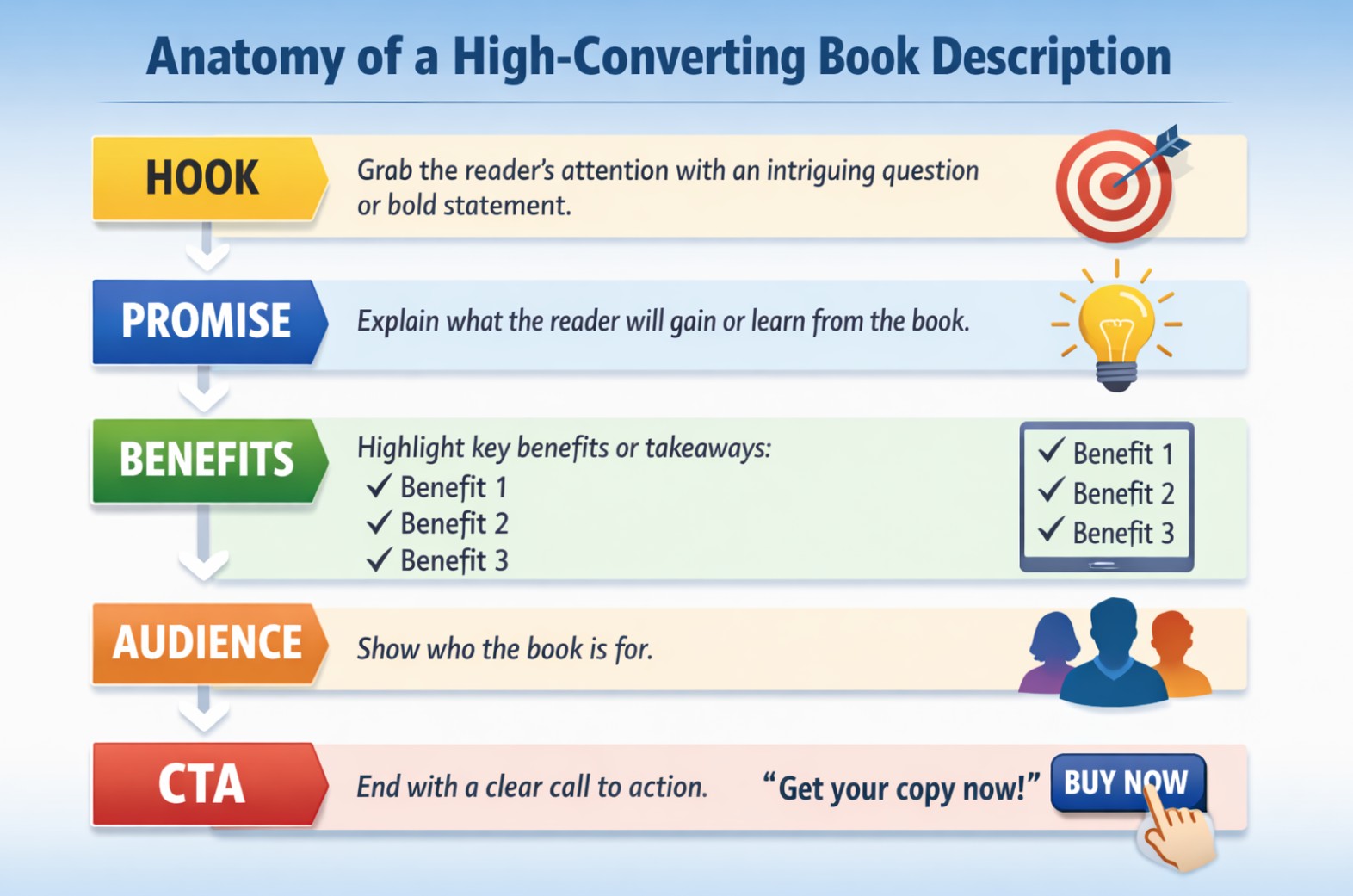
Hook → Promise → Benefits → Audience → CTA
A strong book description usually begins with a hook that captures attention, followed by a clear promise explaining what the reader will gain from the book. This quickly answers the reader’s main question: “Why should I read this?”
The middle section highlights the key benefits or takeaways, often using short bullet points. The description then clarifies who the book is for, helping the right readers recognize themselves.
The final line typically includes a simple call to action that invites the reader to start reading or explore the ideas inside the book.
The AI Book Description Generator follows this same structure automatically. Instead of writing a description from scratch, you can generate several structured drafts and then refine the strongest version so it matches your tone, audience, and genre expectations.
How to Use the AI Book Description Generator
Writing a book description from scratch can take hours of brainstorming and rewriting. The AI Book Description Generator simplifies this process by creating structured drafts based on your book title and chosen marketing strategy.
Instead of staring at a blank page, you can generate multiple description variations and refine the strongest one so it fits your voice, niche, and audience expectations.
- Enter your full book title. Paste the title exactly as it appears on Amazon (Title: Subtitle). This helps the generator understand the promise and positioning of the book.
- Choose a marketing approach. Select the strategy that best matches your genre or message, such as problem–solution, curiosity-driven, authority-based, or story-led positioning.
- Select the number of description variants. You can generate up to three descriptions at once, allowing you to compare different angles and writing styles.
- Choose the target description length. Short blurbs work well for simple books, while longer descriptions allow you to explain benefits, structure, and reader outcomes more clearly.
- Generate and refine. Review the generated drafts, keep the strongest hook and benefits, and edit the text so it reflects your voice and the expectations of your readers.
Many successful authors treat AI-generated descriptions as a starting point rather than the final version. By combining AI structure with your own insights and tone, you can quickly create a description that feels natural and persuasive.
How Long Should an Amazon Book Description Be?
There is no single perfect length for a book description. The best length depends on the type of book, the complexity of the topic, and how much explanation the reader needs before deciding to buy. In general, descriptions should be long enough to communicate value clearly but short enough to remain easy to scan.
Short Description (≈120 words)
A short blurb works well when the concept of the book is simple and easy to understand. The description focuses on a strong hook and a clear promise without too much explanation.
Often used for puzzle books, activity books, journals, and other straightforward formats where readers already understand the concept.
Medium Description (≈180 words)
Medium-length descriptions provide enough space to explain the main benefits of the book while still remaining quick to read.
This format works well for most nonfiction books, guides, and educational topics where readers want a clear overview before deciding.
Standard Description (≈250 words)
Around 250 words is one of the most common lengths for Amazon book descriptions. It allows the author to introduce the hook, explain the promise, list benefits, and clarify who the book is for.
This length works well for both fiction and nonfiction because it balances clarity with readability.
Long Description (≈350+ words)
Longer descriptions are useful when the book teaches a system, method, or complex topic that benefits from additional explanation.
These descriptions often include multiple benefit sections, deeper explanations, and examples to build trust and credibility with the reader.
The AI Book Description Generator lets you experiment with different description lengths. You can generate shorter or longer versions and then choose the one that communicates the value of your book most clearly to potential readers.
Common Book Description Mistakes That Reduce Amazon Conversions
Even a great book can struggle to sell if the description is unclear or difficult to read. Many authors accidentally write blurbs that are too vague, too long, or too focused on the author instead of the reader. Avoiding these common mistakes can significantly improve how readers respond to your book listing.
| Common mistake | Why it hurts conversions | Better approach |
|---|---|---|
| Starting with a long introduction | Readers on Amazon scan quickly. If the description takes too long to explain the point of the book, many visitors simply leave the page. | Begin with a clear hook that immediately shows the value or topic of the book. |
| Writing large text blocks | Long paragraphs are difficult to read on mobile devices, where most Amazon customers browse books. | Use short paragraphs, bullet points, and clear sections to make the description easy to scan. |
| Being too generic | Phrases like “this amazing book will change your life” do not explain what makes the book unique. | Highlight specific benefits, examples, or outcomes the reader will gain. |
| Ignoring the target reader | If the description does not clearly show who the book is for, readers may assume it is not relevant to them. | Include a short section explaining who the book is designed for. |
| Overusing hype and exaggerated claims | Excessive promises can reduce trust and make the description feel like spam. | Focus on clear benefits, realistic outcomes, and a confident but natural tone. |
The goal of a book description is not to impress the reader with complex language but to communicate value clearly and quickly. When the structure is simple and the benefits are obvious, readers are much more likely to continue exploring the book and eventually make a purchase.
Example of a Strong Amazon Book Description
Below is a simplified example of how a well-structured Amazon book description might look. Notice how the text moves from curiosity to value and then to action. This flow helps readers quickly understand what the book offers and whether it is relevant to them.
Hook
What if improving your focus didn’t require extreme discipline or complicated systems?
Problem + Promise
Many people struggle with constant distractions, unfinished tasks, and overwhelming to-do lists. In this practical guide, you will discover a simple framework that helps you regain control of your attention and finish what truly matters.
What you’ll learn
- How to identify the hidden habits that destroy your focus
- Practical techniques for managing attention in a distracted world
- A simple system for turning ideas into completed projects
- Strategies to maintain motivation and long-term consistency
Who this book is for
This book is designed for professionals, students, creators, and anyone who wants to improve productivity without burning out.
Call to action
If you are ready to regain control of your time and attention, start reading today.
You don’t need to copy this exact structure, but the general flow works well because it answers the reader’s key questions quickly: what the book is about, why it matters, and who it will help. The AI Book Description Generator creates drafts that follow a similar structure so you can focus on refining the message rather than inventing it from scratch.
How to Test and Improve Your Amazon Book Description
A book description rarely becomes perfect on the first attempt. Many successful authors improve their blurbs over time by testing different versions and observing how readers respond. Small adjustments to the hook, structure, or benefits can sometimes lead to noticeable changes in reader engagement.
The key idea is simple: change one element at a time. If you modify several things at once—such as the cover, title, keywords, and description—it becomes impossible to understand what actually influenced the results.
- Start with a clear baseline.
Keep the same title, cover, price, and keywords while testing a new description. - Change the hook or opening section.
The first lines often have the biggest impact because they determine whether the reader continues scanning the page. - Test different benefit sections.
Sometimes simply clarifying what the reader will gain from the book can improve conversion. - Watch trends over time.
Instead of reacting to a single day of rank movement, observe patterns across one or two weeks. - Keep the strongest version.
Once you see consistent improvement, keep that version and build on it.
This process does not need to be complicated. Even simple experiments—such as changing the hook, rearranging benefits, or clarifying the audience—can make a description significantly easier for readers to understand.
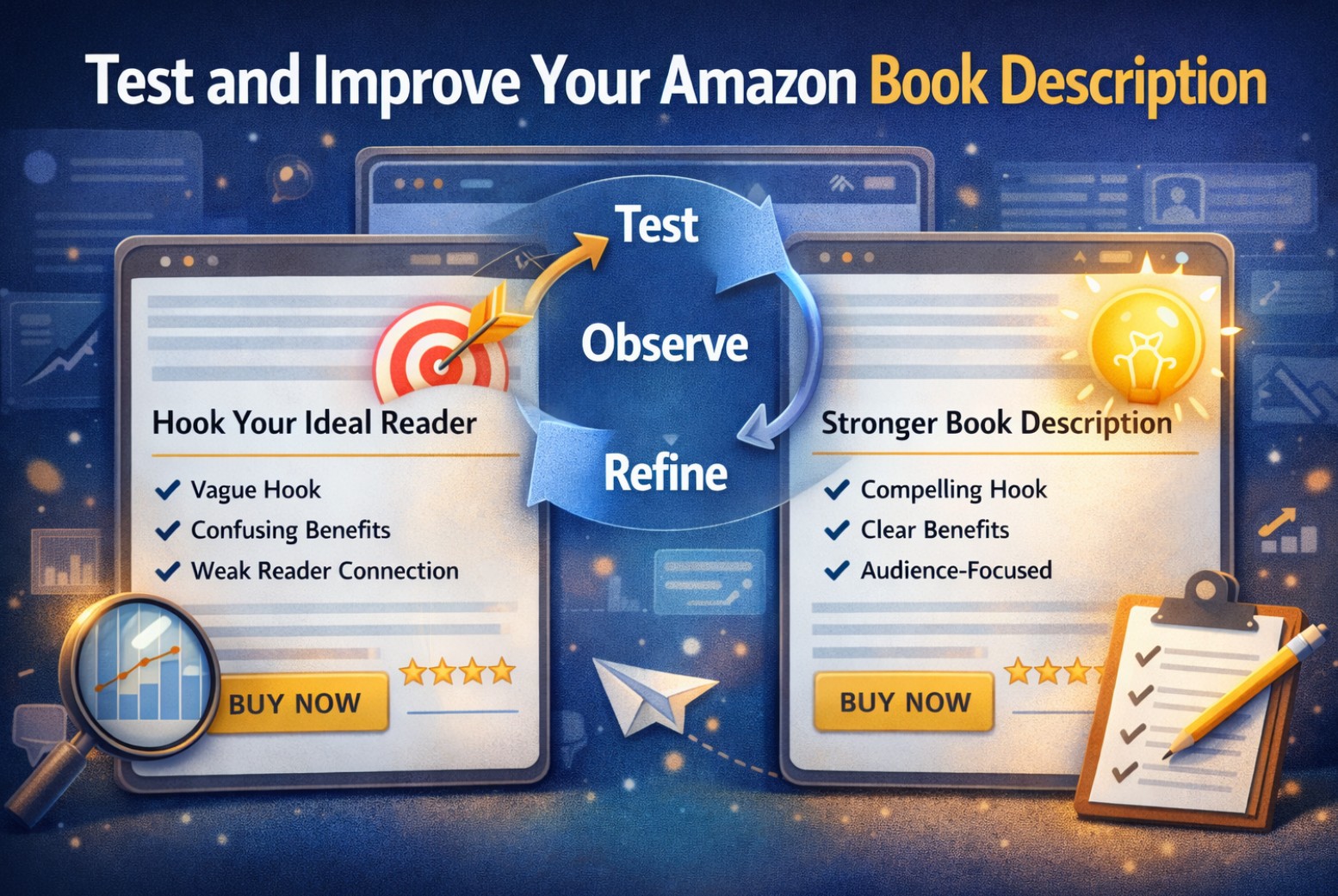
Test → Observe → Refine
Improving a book description is often an iterative process. Authors test a new version, observe how readers respond, and then refine the structure or wording based on what works best.
Small improvements to the hook, benefits, or audience clarity can significantly increase how clearly readers understand the value of the book.
The AI Book Description Generator helps accelerate this process by generating multiple structured drafts quickly. Instead of rewriting everything from scratch, you can compare different approaches and refine the version that communicates the value of your book most clearly.
Frequently Asked Questions About Book Descriptions
Many authors have similar questions when writing or improving their Amazon book descriptions. Below are some of the most common questions about structure, length, and how AI tools can help create more effective blurbs.
What should an Amazon book description include?
A strong book description usually includes a clear hook, a short explanation of the problem or promise of the book, a list of key benefits or takeaways, a section explaining who the book is for, and a simple call to action inviting the reader to start reading.
How long should a book description be on Amazon KDP?
Many effective descriptions fall between 150 and 300 words. Shorter descriptions can work for simple books such as puzzles or journals, while more complex nonfiction topics may benefit from slightly longer explanations.
Can AI write a complete book description?
AI can generate strong drafts and structured blurbs quickly, but the best results usually come from editing the output. Authors often refine the hook, adjust the tone, and add specific details so the description reflects their voice and niche.
Do book descriptions really affect sales?
Yes. While the cover and title attract attention, the description helps readers decide whether the book is relevant and valuable to them. A clear and well-structured description can significantly improve conversion from page visits to purchases.
Should I update my book description after publishing?
Yes. Many authors periodically improve their descriptions based on reader feedback, conversion trends, or better positioning. Testing small changes over time can help identify which messaging resonates most with readers.
Generate a Clear and Compelling Book Description with AI
Writing a strong Amazon book description can take time, especially when you are trying to balance storytelling, clarity, and persuasive structure. Instead of starting from a blank page, many authors now use structured AI tools to generate several drafts quickly and then refine the best version.
The AI Book Description Generator helps you create structured blurbs based on proven marketing approaches such as hook-driven openings, benefit-focused sections, audience targeting, and clear calls to action. By selecting a description strategy and entering your title, you can instantly generate one or several description variants designed for Amazon KDP listings.
Use the generated descriptions as a starting point, test different angles, and refine the message until the description clearly communicates the value of your book to the right readers.
Continue Optimizing Your Amazon Book Listing
A well-written book description is one of the most important elements of an Amazon KDP listing. After creating a clear and persuasive description, the next step is optimizing the title, keywords, and categories so readers can easily discover your book.
AI Book Title Generator
Generate clear and compelling title and subtitle combinations designed for Amazon KDP listings.
Explore different title angles and positioning ideas that can help your book attract attention in search results.
AI Keyword Generator
Discover keyword phrases readers actually use when searching for books on Amazon.
Generate long-tail keyword ideas and topic clusters that can support both organic discovery and Amazon Ads campaigns.
AI Category Finder
Explore relevant Amazon browse categories for Kindle and paperback books.
Choosing the right categories can help your book appear in more relevant shelves and improve visibility inside Amazon.
When a strong title, a clear description, relevant keywords, and well-chosen categories work together, your book has a much better chance of reaching the readers who are already searching for it.