
Amazon KDP Ready Puzzle Generators for Your New Activity Books
Puzzle books are one of the most consistent formats on Amazon KDP. Readers enjoy simple activities such as word searches, Sudoku, mazes, and other brain games, which makes puzzle books a popular category for both children and adults.
Creating puzzles manually, however, can take a lot of time. Building grids, placing words, balancing difficulty levels, and preparing solution pages can quickly turn into hours of repetitive work.
Puzzle generators simplify this process. Instead of constructing every puzzle by hand, you can generate puzzle content automatically and focus on the book concept, theme, and layout. This makes it much easier to experiment with ideas, test niches, and build puzzle book projects for Amazon KDP.
Popular Puzzle Types for KDP Books
Puzzle books on Amazon KDP usually focus on one main puzzle format. Each type attracts a slightly different audience, which allows authors to build multiple puzzle series targeting different readers.
Some puzzle books focus on logic challenges like Sudoku, while others use word-based puzzles such as word searches or crosswords. Activity puzzles like mazes or cryptograms are also common in educational and themed puzzle books.
Using a puzzle generator makes it easy to experiment with different puzzle formats. Authors can test various puzzle types, combine them into themed books, or build entire series around a single puzzle style.
How Puzzle Generators Help Authors Create Books Faster
Creating puzzle books manually can be slow and repetitive. Building grids, placing words, checking puzzle difficulty, and preparing solution pages requires a lot of time when everything is done by hand.
Puzzle generators automate the most technical parts of this process. They can instantly generate Sudoku grids, place words into a word search, create maze paths, or produce crossword layouts. Instead of focusing on puzzle construction, authors can concentrate on designing the book itself.
This makes it easier to organize puzzles by difficulty, structure chapters, add solution sections, and build consistent puzzle books or entire series. With the technical work handled by the generator, authors can focus on the niche, theme, and reader experience.
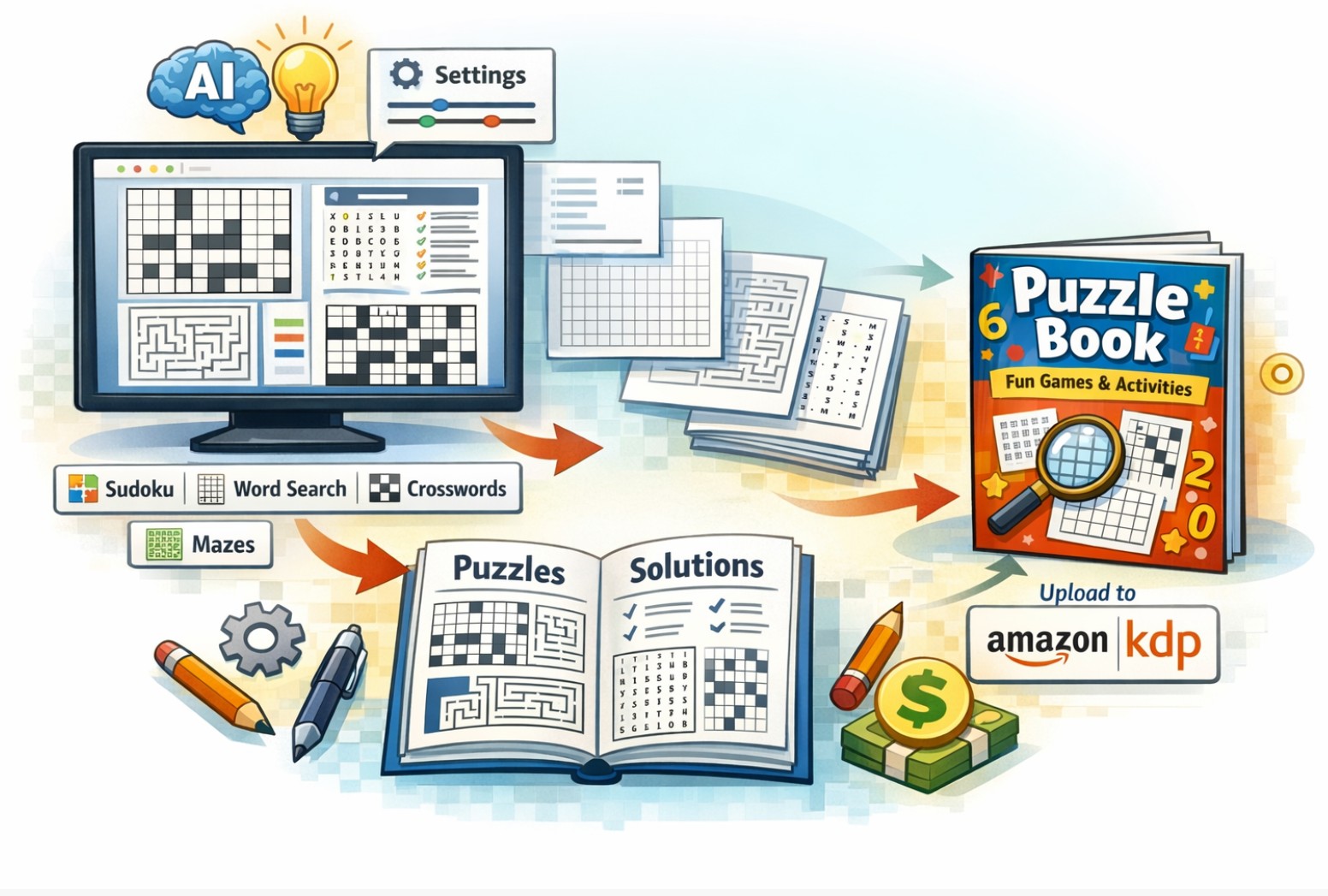
Simple Workflow: From Puzzle Generator to KDP Book
Many authors use puzzle generators as part of a simple publishing workflow. Instead of building every puzzle manually, they generate puzzle content first and then organize it into a structured book ready for Amazon KDP.
| Step | What happens |
|---|---|
| 1. Choose a puzzle type | Decide what kind of puzzle book you want to create — for example Sudoku, Word Search, Crosswords, or Mazes. |
| 2. Generate puzzle pages | Use a puzzle generator to create multiple puzzles quickly instead of building them manually. |
| 3. Organize the book | Arrange puzzles into chapters or sections and balance the difficulty level throughout the book. |
| 4. Add solution pages | Include answer pages so readers can check their solutions. |
| 5. Format and publish | Format the book for print and upload it to Amazon KDP as a puzzle or activity book. |
Create Puzzle Content for Your KDP Books
Once you decide to publish a puzzle book, the next step is producing consistent puzzle pages quickly. This is where a puzzle generator becomes extremely useful. Instead of constructing every puzzle manually, you can generate puzzle content automatically and focus on the creative parts of the book — choosing themes, organizing chapters, and designing a clear reader experience.
Modern puzzle generators support a wide range of puzzle formats that work well for printed books. Authors commonly create Sudoku, Word Search, Crosswords, Mazes, Word Scramble, Cryptograms, Missing Vowels puzzles, and other logic activities.
Many generators also provide flexible configuration options. Authors can control grid size, puzzle difficulty, word lists, puzzle density, layout spacing, and solution formats. This allows you to structure a book with clear progression — starting with easier puzzles and gradually moving toward more difficult ones.
Some modern tools also integrate AI-assisted generation. AI can help produce themed word lists, generate crossword clues, expand vocabulary sets, or create puzzle content based on a specific topic. For example, an author can generate word search puzzles about animals, geography, science, holidays, or educational topics without manually building every word list.
With a reliable puzzle generator, creating puzzle books becomes significantly faster and more scalable. Authors can generate puzzle pages, export clean layouts, prepare solution sections, and assemble complete puzzle books ready for formatting and publishing on Amazon KDP.
PuzzleGenerator.Org – Puzzle Generator for KDP Books
Generate Sudoku, Word Search, Crosswords, Mazes, and other puzzles for printable books and Amazon KDP projects. Create puzzle pages quickly and build complete puzzle books or activity collections.
Expanding Your KDP Catalog with Puzzle Books
Puzzle books remain one of the most stable formats on Amazon KDP. Readers understand them immediately, they work perfectly in print, and new themes can always be created. A single idea can turn into multiple books simply by changing topics, difficulty levels, or puzzle types.
For authors, puzzle generators remove most of the technical work. Instead of spending time building grids and layouts manually, you can focus on the creative part of publishing — choosing themes, organizing puzzles, and designing books that readers enjoy solving.
When used consistently, puzzle generators allow you to build an entire catalog of activity books over time. Each new book becomes another entry point for readers discovering your work on Amazon.
Popular Puzzle Book Niches on Amazon KDP
Puzzle books succeed on Amazon when they target a clear theme or audience. Instead of publishing a generic puzzle collection, many successful authors build books around specific topics, difficulty levels, or reader groups.
| Category | Example Ideas |
|---|---|
| Kids puzzle books | Word search for kids, simple mazes, beginner Sudoku |
| Educational puzzles | Vocabulary word searches, math puzzles, spelling activities |
| Themed puzzle books | Travel puzzles, animals, space, holidays, sports themes |
| Adult puzzle books | Hard Sudoku, large word search, logic puzzles |
| Seasonal puzzles | Christmas puzzles, Halloween word search, summer activity books |
By combining puzzle generators with a clear theme, authors can create entire puzzle book series. A single niche can expand into multiple books, difficulty levels, or seasonal editions.
Common Mistakes When Creating Puzzle Books
Puzzle books may look simple, but small mistakes can make them frustrating for readers. Many beginners publish puzzle books too quickly without checking readability, puzzle difficulty, or page layout.
| Common mistake | Why it causes problems |
|---|---|
| Puzzles are too small | Grids that are difficult to read or solve reduce the enjoyment of the book, especially for printed editions. |
| No solution pages | Readers expect answer pages. Without them, puzzle books feel incomplete and frustrating. |
| Random puzzle difficulty | Mixing very easy and very hard puzzles without structure makes the book feel unbalanced. |
| Weak themes | Generic puzzle books compete heavily. Clear themes or niches make books easier to discover. |
| Manual puzzle creation | Creating puzzles manually takes enormous time and often leads to inconsistent layouts or mistakes. |
Using a reliable puzzle generator helps avoid many of these problems. It allows authors to produce clean puzzles, consistent layouts, and organized difficulty levels before preparing the final book for Amazon KDP.
Puzzle Difficulty Levels
One important detail in puzzle books is difficulty progression. Readers expect puzzles to become gradually more challenging as they move through the book. This structure keeps the experience enjoyable and prevents frustration.
Easy
Simple puzzles designed for beginners or warm-up sections. These puzzles help readers start comfortably and build confidence before moving to harder challenges.
Medium
Balanced puzzles that require attention and logic but remain accessible for most readers. This level usually forms the main part of a puzzle book.
Hard
Complex puzzles designed for experienced solvers who want a stronger challenge. These puzzles are typically placed near the end of the book.
Organizing puzzles by difficulty helps readers stay engaged and gives the book a natural progression from the first page to the final challenge.
Building Puzzle Books with Simple Tools
Puzzle books remain one of the most accessible formats on Amazon KDP. With the right tools, authors can create engaging puzzle content, organize it into themed collections, and publish books that readers enjoy solving.
A good puzzle generator simplifies the process. Instead of spending time building puzzles manually, authors can focus on book ideas, themes, and reader experience while generating consistent puzzle pages ready for publishing.