
Understanding Book Review Sites for Authors
Many authors start searching for book review sites when they reach a common stage in publishing: the book is ready, but visibility and reader response are still limited. Without early feedback, it becomes harder to build trust, improve positioning, and understand how the book is perceived by real readers.
Book review platforms exist to help bridge that gap. They connect authors with readers, reviewers, bloggers, and communities where books can be discovered, discussed, and evaluated. Depending on the platform, this may include advance reader copy distribution, editorial feedback, or exposure to niche audiences.
However, not all review sites serve the same purpose, and not all of them are equally effective for every author. Some are better suited for early launch preparation, others for long-term visibility, and some simply help authors understand their audience more clearly. The key is not just using review sites, but understanding how they fit into a broader publishing workflow.
Different Types of Book Review Platforms
Not all book review sites work the same way. Authors often get confused because they expect every platform to generate the same outcome, but in reality, each type serves a different role inside the publishing workflow. A site that works well for one book or genre may produce very different results for another.
Understanding these differences helps you choose the right platform depending on your goal — whether it’s early feedback, audience discovery, or long-term visibility. Without that clarity, it’s easy to spend time on platforms that don’t match your actual needs.
- ARC Platforms: Focus on distributing early copies to readers before or during launch
- Blogger & Editorial Sites: Help with exposure, features, and curated recommendations
- Directories: Lists of reviewers and blogs where authors can reach out manually
- Reader Communities: Platforms where readers discover and discuss books organically
Each category has its strengths. ARC platforms are useful for structured early feedback, while communities and bloggers may help more with long-term discoverability and niche visibility. Directories, on the other hand, often require more manual work but can still open useful connections.
This is why experienced authors rarely rely on a single site. Instead, they combine different types of platforms depending on their launch stage and audience strategy. Over time, this creates a more balanced and flexible approach to reaching readers.
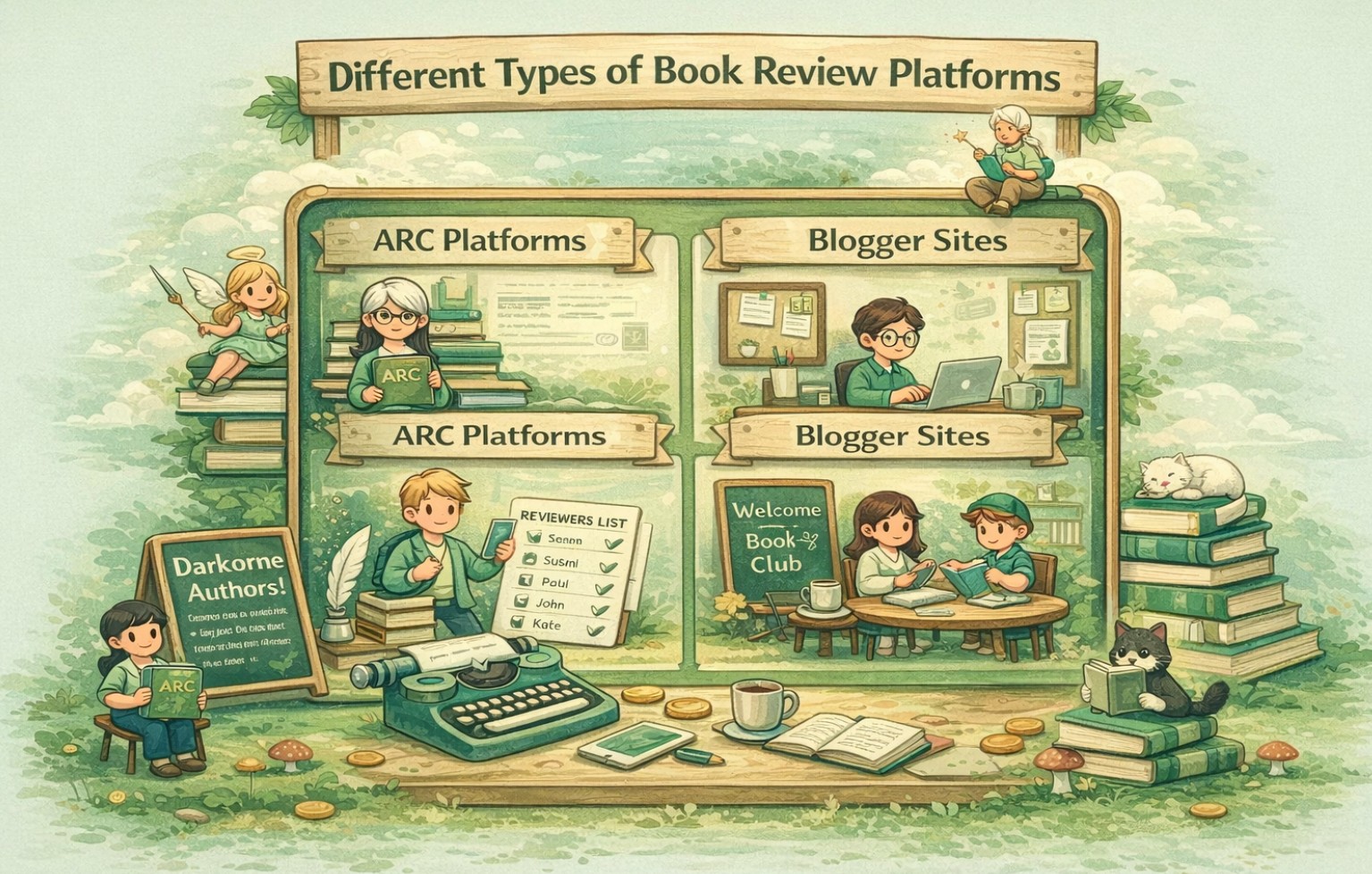
Types of Review Platforms for Authors
ARC tools, blogger platforms, directories, and reader communities each support a different part of the publishing workflow and should be used based on your goals.
Popular Book Review Sites for Authors
Below is a selection of widely used book review platforms and communities. Each of them serves a different purpose, so it’s important to choose based on your current publishing stage and goals.
Some platforms focus on early reader distribution, others on visibility, and some help authors connect with niche audiences. Most authors end up using a combination rather than relying on a single source.
ARC & Reader Distribution Platforms
Blogger & Editorial Discovery Platforms
Reader Communities & Organic Discovery
Hybrid & Promotion Tools
While these platforms can help authors reach readers, they differ significantly in structure, control, and how predictable the outcomes are.
This is why many authors use them as supporting tools rather than complete solutions.
Limitations of Traditional Book Review Sites
Book review sites can be useful, but many authors approach them with expectations that are too high. At first glance, the process seems simple: you submit your book, it becomes visible to readers, and feedback or attention should follow. In reality, the process is much less predictable.
The first limitation is volume. Many platforms have active readers, but that does not guarantee that your specific book will receive attention. Readers often browse multiple titles and select only a few. If your positioning is not immediately clear, your book may still be overlooked.
The second limitation is audience fit. Not every reader on a platform is the right reader for your book. A mismatch between genre, expectations, and reader interest can lead to weak engagement or feedback that does not reflect your target audience.
Another challenge is fragmentation. One platform may help with early distribution, another with blogger outreach, and another with general visibility. Authors often end up using multiple tools without a clear system, which makes the process harder to manage and scale.
Timing is also unpredictable. Some books receive attention quickly, while others take much longer. Even well-prepared books may experience uneven results depending on platform activity and reader interest.
Finally, exposure alone does not solve deeper publishing challenges. If a book has weak positioning, unclear metadata, or does not match reader expectations, simply placing it on more platforms may not improve results.
In simple terms, review sites can help create opportunities, but they do not replace strategy. They work best when combined with clear positioning, the right audience, and a structured approach to publishing.
How to Use Book Review Sites More Effectively
Book review sites give better results when they are used with a clear goal. If you simply upload a book and wait for attention, the outcome is often weak. If you understand what each platform is meant for, the same tools become much more useful.
Start by matching the platform to your current stage. Some sites work better before or during launch, when you need early reader response. Others are more useful for outreach, discovery, or long-term visibility inside a niche.
- Use ARC platforms to place early copies with interested readers
- Use directories and bloggers to expand reach across different audiences
- Use reader communities to build slower, organic visibility over time
- Use hybrid tools to combine distribution with audience growth
Preparation matters just as much as the platform itself. A clear cover, strong positioning, and a description that matches reader expectations make a noticeable difference in how the book performs across these sites.
Results also vary. Some books attract attention quickly, while others take longer to gain traction. Genre, competition, and audience fit all influence the outcome. Review platforms work better when they are treated as part of a steady process rather than a one-time action.
Over time, patterns become visible. Some platforms bring more relevant readers, others bring better engagement, and some are simply not a good match. Authors who pay attention to these signals usually build a more stable workflow.
Why Many Authors Move Beyond Review Sites
After working with several review platforms, many authors notice the same pattern. Individual sites can bring some exposure or feedback, but the overall process often feels scattered. Each platform solves a small part of the problem, but none of them creates a complete workflow on its own.
This usually leads to a fragmented setup. One site is used for early copies, another for outreach, another for discovery. Managing all of this takes time, and the results are not always consistent. Some books gain traction, others remain almost invisible despite being listed on multiple platforms.
Over time, the focus shifts from “finding more sites” to building a more structured approach. Authors begin to look for ways to organize reader interaction, track what is happening, and improve how their books are positioned in front of the right audience.
- Working with the right readers instead of broad, unfocused traffic
- Building a clear workflow instead of using disconnected platforms
- Focusing on actions that improve visibility over time
- Keeping the process consistent instead of relying on one-time efforts
This is where many authors begin to move toward more structured solutions. Instead of relying only on external directories and outreach, they start using tools and systems that help organize the process and make it easier to repeat and improve.
Book review sites still play a role, but they become just one part of a broader publishing workflow rather than the main strategy.
Comparing Different Types of Book Review Platforms
Each type of platform supports a different part of the publishing process. Understanding these differences makes it easier to choose the right approach instead of relying on a single site.
| Platform Type | Best Use Case | What It Helps With | Typical Limitation |
|---|---|---|---|
| ARC Platforms | Pre-launch and early reader access | Initial feedback and early visibility | Results vary depending on reader interest and genre fit |
| Blogger & Directories | Manual outreach and exposure | Connections with reviewers and niche blogs | Time-consuming and requires consistent effort |
| Reader Communities | Organic discovery and engagement | Long-term visibility and audience interaction | Slow growth and less predictable traction |
| Hybrid Tools | Distribution and audience building | Combining exposure with list growth | Still requires external platforms for full workflow |
Most authors use several of these approaches together. Each one covers a specific need, but none of them fully replaces a structured publishing workflow.
Choosing the Right Approach for Your Book
There is no single platform that works for every book. Results depend on genre, positioning, audience expectations, and the stage of publishing. What works well for one author may not produce the same outcome for another.
A more reliable approach is to combine different tools and adjust them over time. Some authors focus on early reader distribution, others on outreach, and others on building visibility inside specific communities. The best results usually come from aligning these steps with a clear publishing plan.
Book review sites can support this process, especially when they are used with the right expectations and a clear understanding of their role. They are most effective when combined with strong positioning, relevant audience targeting, and consistent execution.
Authors tend to move toward more structured workflows where discovery, feedback, and visibility are easier to manage and repeat. This shift helps turn isolated actions into a more stable and predictable publishing process.