
Amazon BSR Psychology: How to Stay Calm, Consistent, and Strategic When Your Rank Moves
This page is a mindset companion to the Amazon BSR Calculator. The calculator gives you estimates — this page helps you use them without panic-editing your book every time your BSR jumps up or down.
BSR changes quickly — and that’s exactly why it can mess with your mindset. A small dip can feel like failure. A sudden spike can feel like success. In reality, both are often just short-term signals reacting to recent activity.
The goal is not to stop watching BSR — it’s to stop reacting impulsively. When you understand what BSR is (and what it isn’t), you can stay focused on the things that actually build momentum: conversion quality, review timing, and consistent launch actions.
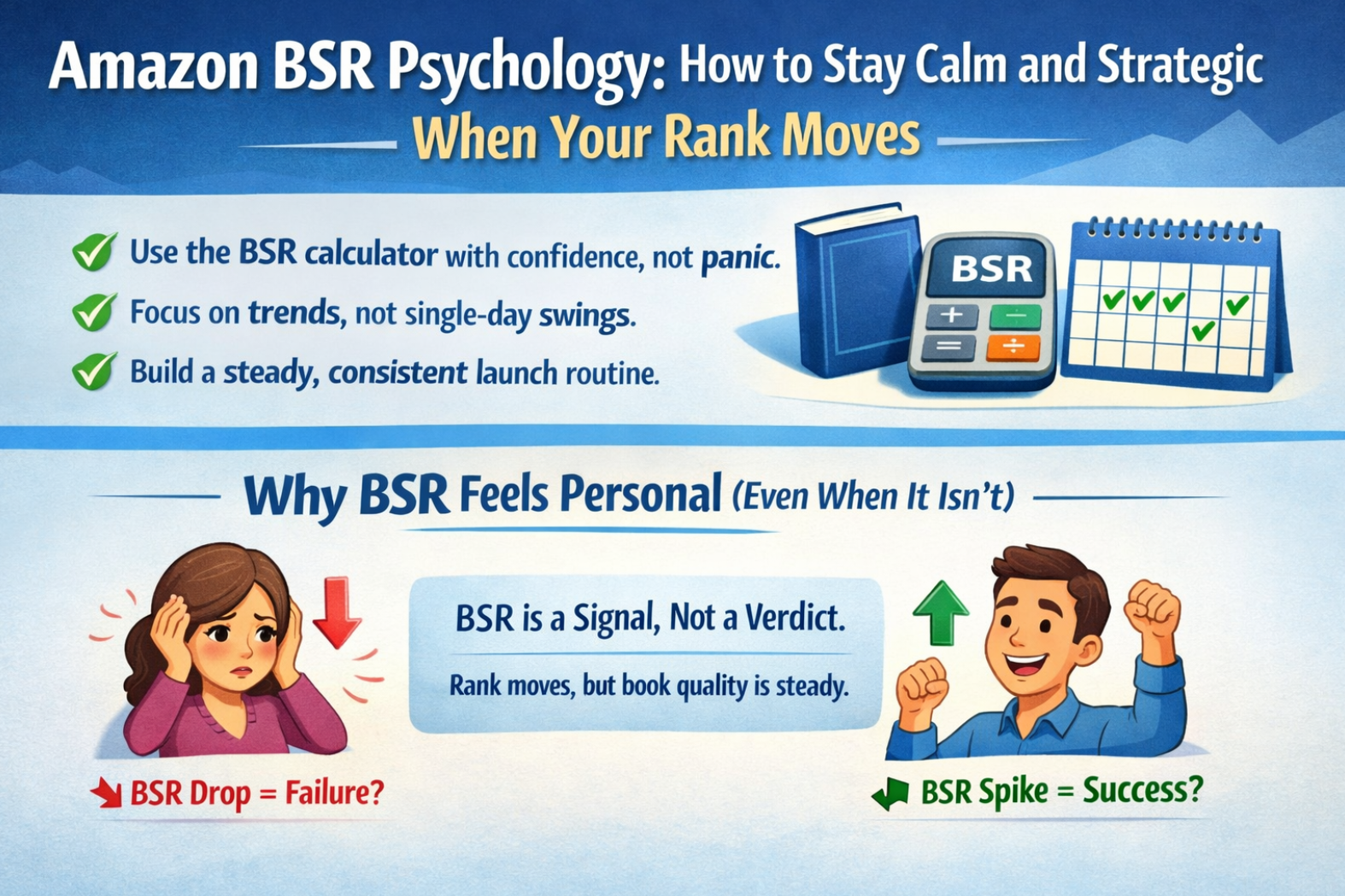
BSR Is a Signal — Not a Verdict
Amazon BSR moves fast and reacts to short-term sales activity. That speed makes it emotionally powerful, but it doesn’t reflect your book’s quality or long-term potential.
Calm interpretation beats fast reactions. Focus on trends, not single-day spikes, and use BSR to guide decisions — not to judge your launch.
Watch direction · Ignore noise · Act on patterns
Why BSR Feels Personal (Even When It Isn’t)
Amazon BSR updates often and publicly. That combination makes it feel like a judgment — as if the market is constantly grading your book in real time. A green arrow feels like validation. A red arrow feels like rejection.
But BSR isn’t measuring effort, quality, or long-term potential. It’s reacting to short-term sales velocity inside a moving category. When other books launch promos, ads turn on or off, or seasonal demand shifts, your rank can move even if nothing about your book changed.
The psychological mistake is attaching meaning to every movement. Treating a dip as failure or a spike as proof of success leads to impulsive changes — price tweaks, metadata edits, ad resets — that often do more harm than good.
Once you separate rank movement from book quality, you can use BSR in a healthier way: check it on a schedule, compare it to your plan, and only change one lever at a time when a real trend shows up.
The BSR Anxiety Loop (and How It Breaks Momentum)
Most launch mistakes don’t happen because authors don’t know what to do. They happen because BSR moves fast — and the brain tries to “fix” the feeling immediately. That’s how a normal rank dip turns into a chain of impulsive changes.
The loop usually looks like this: you check BSR, see a drop, feel a hit of anxiety, and then change something to regain control — price, ads, keywords, categories, cover, blurb. The next day the rank moves again (because it’s noisy), and now you’re chasing a moving target.
- Step 1: Check BSR too often → every movement feels urgent.
- Step 2: Panic edit → multiple changes at once, no clean data.
- Step 3: Conversion gets unstable → momentum breaks.
- Step 4: More checking → more anxiety → repeat.
The biggest problem is not the dip — it’s destroying your own baseline. When you change five things in two days, you can’t tell what worked, what failed, or what caused the rank movement.
Calm launches aren’t passive. They’re structured. You’re still taking action — you’re just doing it on a schedule that produces real signals instead of emotional noise.
What You Can Control (and What You Can’t)
BSR feels stressful when it’s treated like a steering wheel — as if you can turn it directly. In reality, BSR is closer to a dashboard light: it reflects what’s happening, but it’s not the lever itself. The fastest way to calm down is to separate controllable actions from uncontrollable noise.
Use this as a mental filter. If something is in the “Not in your control” column, don’t spend emotional energy on it. Focus on the inputs that actually improve conversion and support review momentum.
| In your control | Not in your control |
|---|---|
|
|
If you’re unsure what to do after a dip, return to the left column. Pick the single most important lever, confirm it with a 3–7 day trend, and act once — not five times.
Use the BSR Calculator the Calm Way: Snapshot → Range → Plan
The Amazon BSR Calculator works best when it’s used as part of a routine — not as a reaction to every rank movement. Its real value is helping you turn noisy signals into a clear planning range.
A calm workflow looks like this:
- Take a snapshot.
Capture BSR at a consistent time (or a couple of times across one day). Avoid using promo spikes or extreme one-hour movements. - Convert rank into a range.
Run the snapshot through the calculator to see estimated unit ranges, not a single “magic” number. - Match the correct quarter.
Always align seasonality with the moment you captured the BSR — not with hopes, forecasts, or future plans.
Use the BSR calculator to confirm Amazon Sales trends before acting. - Decide one action.
Based on the range, pick one lever to adjust: price, ads, or review pacing. Leave everything else untouched. - Wait for a signal.
Give changes 3–7 days before evaluating results. Momentum needs time to show itself.
The purpose of the Amazon BSR Calculator is not to predict exact numbers, but to help you translate rank movement into reasonable sales ranges. From there, you can plan review pacing, launch actions, and post-launch optimization without reacting emotionally to every rank change.
This process replaces emotional checking with intentional planning. You’re still paying attention to BSR — you’re just doing it in a way that produces insight instead of stress.
Why One-Day BSR Swings Don’t Mean Anything
One of the biggest mindset shifts is accepting that daily BSR movement is mostly noise. Amazon BSR reacts quickly to recent purchases, but it also reacts to what other books in your category are doing at the same time.
That means your rank can move even if your own sales stayed the same. A competitor turns ads on. A promo ends. A category gets a temporary demand spike. From the outside, it looks like “something happened” — but nothing actually changed in your listing.
When authors treat every daily swing as a signal, they end up overcorrecting. The launch becomes unstable, and real trends get buried under constant adjustments.
Calm interpretation doesn’t mean ignoring data. It means zooming out just enough to see whether momentum is actually building, stalling, or holding steady.
The Motivation Trap: “I Need a Better BSR” vs “I Need a Better System”
Many authors think motivation comes from seeing a better rank. In practice, the opposite is true. Chasing BSR numbers usually increases stress, shortens patience, and leads to inconsistent decisions.
A healthier mindset is shifting motivation away from outcomes and toward the system that produces them. The table below shows the difference.
| Motivation based on rank | Motivation based on system |
|---|---|
|
|
Systems create momentum. Ranks only reflect it. When your motivation comes from the process, BSR becomes feedback — not a source of pressure.
Two Simple Checklists That Keep You Sane
Checklists remove emotion from decisions. Instead of asking “What should I do now?”, you follow a short sequence that protects momentum and keeps your data clean.
When BSR Drops
- Pause for 24 hours. Don’t change price, ads, or metadata the same day.
- Check sales first. If units are stable, the drop is likely noise.
- Review the chain. Sales → reviews → momentum (what is actually lagging?).
- Change one lever only. Price or ads or review pacing.
- Wait 3–7 days. Let the system respond before judging results.
When BSR Spikes
- Don’t rush discounts. Early spikes often fade naturally.
- Protect conversion. Avoid last-minute edits to cover or blurb.
- Let reviews catch up. Sales usually lead, reviews follow.
- Maintain ads. Stability matters more than aggressive scaling.
- Capture the snapshot. Save the BSR and compare it over the next few days.
Both scenarios use the same principle: protect the baseline. A stable system turns short-term movement into long-term progress.
A Simple 14-Day Framework to Stay Focused After Launch
Most launch stress comes from not knowing what “normal” looks like. A simple time frame removes that uncertainty. Instead of reacting day by day, you operate inside a short, repeatable cycle.
Here’s a calm two-week framework many authors use to stay grounded while BSR settles.
| Days | Primary focus | What to avoid |
|---|---|---|
| Days 1–7 | Stabilize the listing: conversion clarity, steady ads, early review pacing. | Panic edits, daily price changes, overanalyzing rank swings. |
| Days 8–14 | Optimize gently: one planned change based on trends, not emotions. | Resetting the entire strategy or chasing short-term spikes. |
This framework doesn’t promise perfect results — it protects momentum. By the end of two weeks, you’ll have cleaner data, steadier reviews, and a much clearer signal than any single-day rank check can give.
How Review Timing Supports Motivation (and Why Delays Are Normal)
Reviews play a huge role in motivation — but they almost never arrive on the same timeline as sales. This mismatch is one of the main reasons authors feel discouraged right after launch, even when things are actually going well.
Sales usually come first. BSR reacts quickly to that activity. Reviews, however, depend on real people finishing the book, forming an opinion, and then deciding to leave feedback. That process takes time.
When authors expect reviews to appear immediately, every quiet day feels like failure. In reality, delayed reviews are a sign of normal reader behavior — not a broken launch.
A healthier approach is thinking in waves. Early sales create visibility. Visibility creates readers. Reviews then arrive later and help stabilize conversion.
What often causes confusion is timing. Sales, reviews, and BSR do not move together. Sales usually come first, BSR reacts almost immediately, and reviews often appear later. This delay is normal, especially during launches and ARC-driven campaigns.
When review activity is paced and intentional, it reduces pressure. You stop checking BSR for reassurance and start focusing on steady progress instead.
Build a System, Not a Mood
Amazon BSR will always move. That’s not a bug — it’s how the marketplace works. The real difference between stressed launches and stable ones is not talent or luck, but whether decisions are driven by emotion or by a system.
When you rely on mood, every rank change feels personal. When you rely on a system, rank becomes feedback — useful, neutral, and temporary.
A simple system is enough: consistent snapshots, realistic ranges, one planned action at a time, and patience to let signals develop. This approach doesn’t eliminate uncertainty — it makes it manageable.
If you keep building calmly — book by book, launch by launch — momentum compounds. And over time, the emotional swings matter less than the system you return to every time.