

Amazon Ads Types Explained for Authors
Choose between a single-book listing, an author collection and video by the task, the catalog and the access you actually have.
This comparison separates author-specific formats from general seller advertising and distinguishes ad products from targeting and bidding settings.
Amazon Ads types explained for authors, not general retail sellers
Start with the two author advertising products described by KDP: Sponsored Products and Sponsored Brands. Within Sponsored Brands, collections and video serve different creative jobs. Automatic targeting, exact match and dynamic bidding are settings, not additional advertising products.
A seller-focused list of every Amazon format is not a reliable menu for a KDP account. Availability depends on the account, country, title and current rollout. Use the beginner setup guide once you choose a route, or the mechanics guide to understand cost and measurement.
Author-specific public guidance was read directly; KDP setup guidance was also checked as indexed official text after direct access failed. Console availability, moderation and the actual account still need checking before commissioning creative.
| Option | Best initial job | Access check | Preparation and measurement |
|---|---|---|---|
| Sponsored Products | Test discovery of one eligible edition | Book and account eligible in the chosen marketplace | Inspect the listing; measure relevant traffic and contribution |
| Sponsored Brands collection | Introduce a coherent author catalog | At least three eligible unique titles under one author name, claimed in Author Central | Choose books that belong together; inspect the configured destination |
| Sponsored Brands video | Communicate a book's premise or demonstrate its content | Sponsored Brands author eligibility still applies | Produce rights-cleared video; measure downstream results as well as attention |
| Display / Amazon DSP | Separate display or programmatic planning where available | Do not assume access through ordinary KDP author setup | Check inventory, buying model, eligibility and measurement independently |
KDP's advertising overview is the starting source for author access. The table is a decision aid, not a claim that every option appears in every account. Check the live campaign builder before commissioning assets.
1. Sponsored Products: introduce one book edition
Sponsored Products links the advertised listing to its detail page and uses CPC pricing. It is a practical first test when you want to understand demand and economics for a particular book without first creating a catalog campaign.
What to prepare
Inspect the cover, exact edition, description, sample, price and availability. For an activity book, make the interior and intended difficulty clear. For fiction, the cover and description should honestly communicate the genre. An ad that attracts the wrong reader is not useful just because it earns clicks.
What not to assume
Do not assume that Sponsored Products means automatic targeting only, that all clicks cost the base bid, or that a higher budget guarantees more suitable readers. A campaign's product, targeting and bidding choices are separate decisions.
The general Sponsored Products page describes capabilities across advertiser groups, including newer video and off-Amazon placements. It is not evidence that a particular KDP author can use every feature. Verify author access before treating a retail-seller announcement as a book-ad instruction.
2. Sponsored Brands collections: show books that make sense together
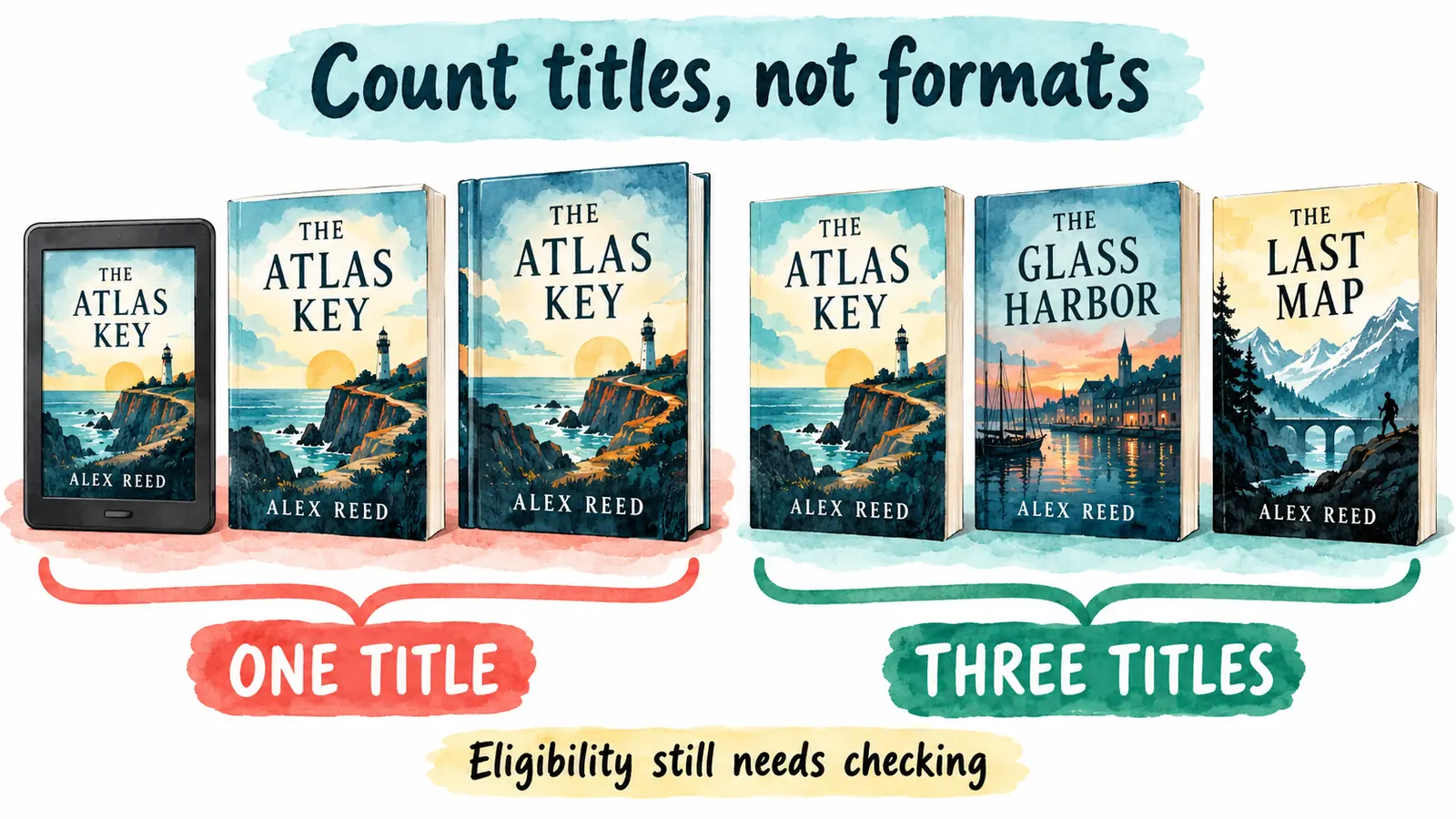
Amazon's author-specific Sponsored Brands guide requires at least three eligible titles claimed under the same author's name in Author Central. Multiple formats of one book are not three unique titles. The guide describes collections and video; use the actual builder to confirm book counts, creative options and destination.
Fictional catalog check: a Kindle, paperback and hardcover of The Atlas Key remain one unique title. The Atlas Key, The Glass Harbor and The Last Map are three distinct titles, but they still need the required author claims, eligible books and marketplace access. Three books scattered across unrelated pen names do not satisfy the same-author check merely because you own them.
When a collection is a good fit
A connected mystery series or three practical books for the same audience gives a reader a coherent choice. A mixed catalog of toddler activities, technical accounting and horror under unrelated pen names is not automatically a collection worth promoting together.
Choose the catalog's role before selecting covers: introduce the author, help a reader find the correct series entry, or offer related solutions. Check that titles and reading order are clear after the click. Eligibility alone is not a reason to launch; the grouped books need a shared reader.
Measure the collection's actual job
Inspect the configured landing destination and reporting scope. A click on author branding and a click on an individual cover may lead to different experiences. Do not infer that every advertised title received an equal share of traffic or count all catalog sales as incremental campaign income.
Collections also create maintenance work. Recheck availability when a title is revised, a price changes or distribution rights change. Remove a broken destination before scaling a campaign that sends readers there.
3. Sponsored Brands video: explain something worth seeing
Video is a format within Sponsored Brands, not a shortcut around its author eligibility. A video featuring one title does not remove the account's three-title requirement. Confirm access first, then confirm the current creative specifications and destination for the selected format.
A useful book video is not necessarily a cinematic trailer
For practical nonfiction, show a real diagram and the reader problem it addresses. For an activity book, demonstrate one legitimate interior task. For fiction, show a concise premise and tone without presenting invented reviews, awards or bestseller claims as fact. Use only assets, music and excerpts you have permission to advertise.
Fictional creative brief: "Show one balcony planting layout from the book, then the matching checklist, then the correct cover. Explain that this is a beginner guide for small outdoor spaces. The next action is to inspect the book page, not to expect a guaranteed harvest."
This is an editorial example, not a required ad script or an existing campaign. It demonstrates a reason to use motion: a viewer can see how the book helps. A decorative animation that explains nothing may add production cost without improving reader fit.
- Make the content understandable without depending on sound.
- Keep text readable on a phone and allow enough time to read it.
- Use the actual edition and accurate contents.
- Check music, image, font and quotation permissions.
- Verify the current video specifications, moderation result and click destination.
Views and completion rates describe attention, not author earnings. Judge a sales test using its attributed outcomes and royalty-based economics, while allowing for reporting differences. Include creative production cost when comparing a video test with a simpler listing campaign.
4. Why Display and Amazon DSP are not default KDP steps
Amazon's Display offering and the current Amazon DSP page address broader advertising needs. Amazon now describes the former DSP capabilities within Ads Agent and Display, Video, and Audio (DVA+). Older tutorials may still say Sponsored Display or DSP. Do not borrow seller eligibility, audience features, inventory or buying models and present them as features every author can activate.
If a publisher, agency or an eligible separate business account proposes these routes, ask for the actual product name, account access, destination, pricing basis, service fees, creative obligations and measurement plan. CPC and impression-based buying are not interchangeable; an impressive reach number does not answer whether a book campaign can recover its costs.
For a first self-published title, an unavailable advanced format is not a missing prerequisite. A focused eligible campaign can be evaluated without building a full advertising stack. Keep the decision proportional to the catalog and the loss you can afford.
5. Format, targeting and bidding answer different questions
| Decision | Question it answers | Example |
|---|---|---|
| Ad product / format | What experience is advertised? | Single-book listing, collection or video |
| Targeting | Which shopping contexts can match? | Automatic discovery or a chosen relevant target |
| Match type | How constrained is keyword matching? | Broad, phrase or exact within supported keyword targeting |
| Bidding | How does the campaign compete? | Base bid and available bid strategy |
| Budget | How much spending is authorized? | Configured budget plus current delivery rules |
Do not copy a Sponsored Products strategy into Sponsored Brands without checking which controls are supported. A video test can also be a keyword-targeted test; calling those two different "ad types" obscures what changed. Record one explicit hypothesis per experiment.
6. Choose the next format from your actual situation
| Situation | Reasonable next step | Why not expand yet? |
|---|---|---|
| One newly published book | Check Sponsored Products eligibility and page readiness | No qualifying author collection yet |
| Three related titles, no campaign history | Choose a measurable single-book or collection hypothesis | More formats divide attention and allowance |
| Illustrated guide with useful demonstrations | Consider a video test if author access and rights are clear | Production cost still needs justification |
| Clicks but no affordable purchases | Investigate relevance, destination and economics first | Changing format does not necessarily fix the offer |
| Publisher planning broader reach | Evaluate additional products with a separate scope and contract | Do not compare unlike attribution or buying models |
7. Write a brief before commissioning creative
Record the eligible account and marketplace, selected product, intended reader, book editions, destination, truthful message, required assets, loss allowance and decision date. Add who will maintain the campaign and who can pause it. Check availability before paying for a trailer that the intended account cannot use.
For comparisons, keep the edition, price, territory and observation period as consistent as practical. Note production and management costs separately. The goal is a decision about the format's job, not a leaderboard of screenshots with incompatible metrics.
Continue with first-campaign setup and measurement and contribution calculations. Use the Ads hub to choose later optimization topics, and the long-term marketing guide to fit advertising into a sustainable publishing plan.
Use the publishing ROI calculator to include incremental creative and management costs in a scenario, and the bounded-test record to compare like periods. Do not book an unavailable format to make the plan look complete.
Sources and scope
Official KDP and Amazon Ads documentation checked: 17 October 2026. Author-specific guidance takes priority over assumptions drawn from general seller marketing. Examples are fictional planning scenarios. Formats, eligibility and creative requirements can change; verify the actual account and current specifications before spending.
Frequently asked questions
Which Amazon advertising products are described for KDP authors?
KDP's author guidance describes Sponsored Products and Sponsored Brands. Collections and video are formats within Sponsored Brands. Confirm current title, account and marketplace eligibility; a general seller feature list is not an author-account guarantee.
How many books do authors need for Sponsored Brands?
Amazon's author guidance requires at least three eligible unique titles under the same author's name, claimed in Author Central. Different formats of one book are not three unique titles. Verify the current requirements and selected collection configuration.
Can a one-book author bypass Sponsored Brands eligibility with video?
No. Video is a Sponsored Brands format, not a separate route around the author eligibility requirement. A video that features one title does not mean a one-title catalog qualifies.
Are automatic and manual targeting different ad types?
They are targeting settings, not advertising products. Likewise, broad, phrase and exact are keyword match types, and dynamic bidding is a bidding choice. Separate those decisions when documenting a test.
Are Display and DSP standard steps in KDP advertising?
Do not assume that broader display or programmatic products have the same access and workflow as KDP-sponsored book ads. Amazon's current materials describe Display, Video, and Audio and Ads Agent terminology. Verify actual account access, pricing, inventory and measurement before planning a campaign.
How should I choose between a listing, a collection and video?
Choose by the job: test one edition, introduce a coherent catalog, or show something useful about the book. Then check eligibility, destination, production cost and a measurable hypothesis. More creative complexity does not guarantee better sales economics.